How to use this calculator
Integrate a constant-geometry Paris crack-growth law between two crack lengths under a fixed stress range.
- Enter Initial crack length (mm), Final crack length (mm), Paris coefficient in m-cycle MPa units, Paris exponent, then complete the remaining labeled fields. Match the units shown beside each field and review the result together with the assumptions below.
- Read the worked example below to check the expected input format and result.
- Compare another scenario by changing one input at a time. Use Reset to return to the starting values.
Paris law constant range crack growth cycles explained
Under a constant stress range and geometry factor, Paris law gives crack-growth rate as a power of stress-intensity range. Integrating that rate between the entered crack lengths estimates the number of cycles across that interval.
Inputs, symbols, and units
a0— Initial crack length (mm)- Length in millimetres.
a1— Final crack length (mm)- Length in millimetres.
C— Paris coefficient in m-cycle MPa units- Coefficient for da/dN in metres per cycle and delta K in MPa sqrt(m), raised to the entered m. A millimetre-based coefficient requires conversion.
m— Paris exponent- Dimensionless Paris-law exponent; it also determines the units carried by coefficient C.
Y— Constant geometry factor- Constant dimensionless crack-geometry factor across the whole integrated growth range.
ds— Stress range delta sigma (MPa)- Full cyclic stress range in MPa, not the half-range amplitude.
Formula and method
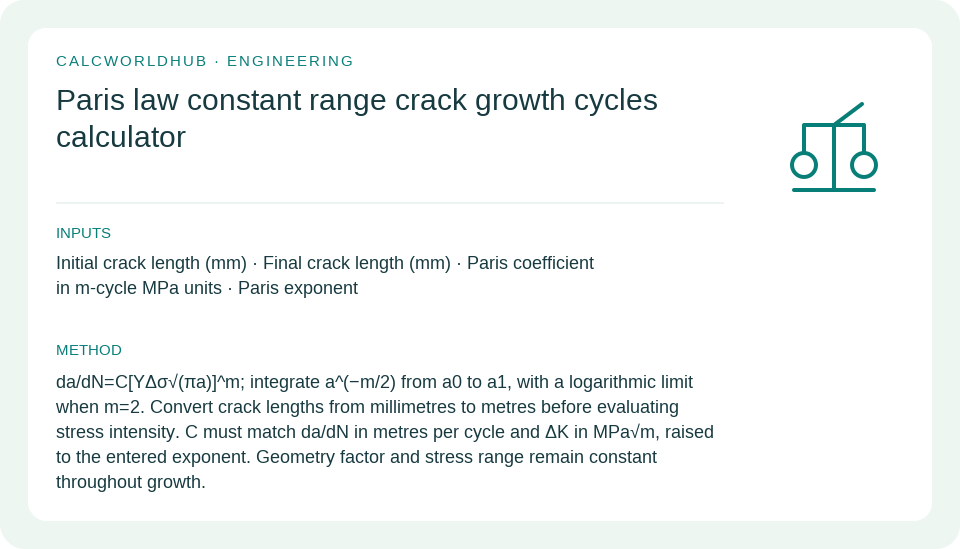
da/dN=C[YΔσ√(πa)]^m; integrate a^(−m/2) from a0 to a1, with a logarithmic limit when m=2.
Convert crack lengths from millimetres to metres before evaluating stress intensity. C must match da/dN in metres per cycle and ΔK in MPa√m, raised to the entered exponent. Geometry factor and stress range remain constant throughout growth.
A worked scenario
Initial crack length (mm) = 1; Final crack length (mm) = 8; Paris coefficient in m-cycle MPa units = 1.00000000e-12; Paris exponent = 3; Constant geometry factor = 1.12; Stress range delta sigma (MPa) = 80.
- Paris law growth cycles: 10207369.108523 cycles
- Initial stress intensity range: 5.02207213 MPa sqrt(m)
- Final stress intensity range: 14.20456503 MPa sqrt(m)
The crack grows from one to eight millimetres under an eighty-MPa stress range. The final stress-intensity range exceeds the initial one because it scales with square root of crack length.
Assumptions and edge cases
Paris-region growth only. No threshold, near-fracture acceleration, crack closure, residual stress, changing geometry, or spectrum effects. The final crack length is supplied; the tool does not decide a critical or safe crack size.
Reading the outputs
The integrated cycle count is conditional on the supplied material law. A coefficient copied from a millimetre-based source without conversion can create a very large error.
Frequently asked questions
Is delta sigma the amplitude?
No. It is the full cyclic stress range used by the chosen Paris-law data.
Can Y vary as the crack grows?
Not in this closed-form constant-Y calculation.
Does reaching a1 imply fracture?
No. A separate fracture criterion is needed to justify the chosen endpoint.
How do I use the Paris law constant range crack growth cycles calculator?
Enter Initial crack length (mm), Final crack length (mm), Paris coefficient in m-cycle MPa units, Paris exponent, then complete the remaining labeled fields. Match the units shown beside each field and review the result together with the assumptions below.
What is a worked example of Paris law constant range crack growth cycles?
Initial crack length (mm) = 1; Final crack length (mm) = 8; Paris coefficient in m-cycle MPa units = 1.00000000e-12; Paris exponent = 3; Constant geometry factor = 1.12; Stress range delta sigma (MPa) = 80. Paris law growth cycles: 10207369.108523 cycles Initial stress intensity range: 5.02207213 MPa sqrt(m) Final stress intensity range: 14.20456503 MPa sqrt(m) The crack grows from one to eight millimetres under an eighty-MPa stress range. The final stress-intensity range exceeds the initial one because it scales with square root of crack length.
Background or definition reference: NASA variable-amplitude fatigue and Paris-law limits.
Read our calculation methodology.