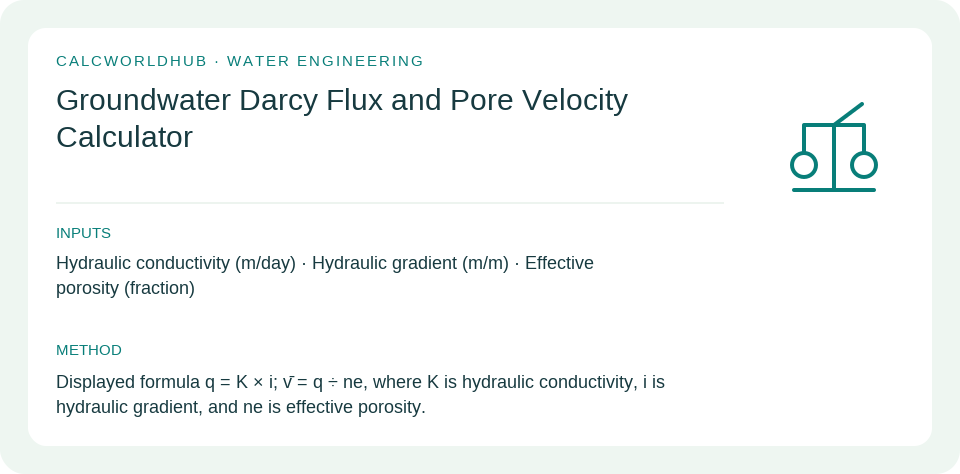
How to use this calculator
Convert hydraulic conductivity and gradient into Darcy flux and average linear groundwater velocity.
- Enter Hydraulic conductivity (m/day), Hydraulic gradient (m/m), Effective porosity (fraction). Match the units shown beside each field and review the result together with the assumptions below.
- Read the worked example below to check the expected input format and result.
- Compare another scenario by changing one input at a time. Use Reset to return to the starting values.
How this calculation works
Darcy flux is discharge per unit bulk cross-sectional area; average linear groundwater velocity accounts for the effective pore space available to flow. The two values differ by effective porosity, which is why a Darcy flux alone should not be read as the speed of groundwater through pores.
Inputs and units
conductivity— Hydraulic conductivity (m/day)- Use conductivity along the direction of flow.
gradient— Hydraulic gradient (m/m)- Dimensionless head change divided by distance along the flow path.
effectivePorosity— Effective porosity (fraction)- Enter the connected mobile pore fraction as a value greater than 0 and at most 1.
Formula
q = K × i; v̄ = q ÷ ne, where K is hydraulic conductivity, i is hydraulic gradient, and ne is effective porosity.
Method
Multiply the hydraulic conductivity by the dimensionless hydraulic gradient to obtain Darcy flux (specific discharge). Divide that flux by effective porosity to estimate average linear pore velocity. Use consistent length and time units for conductivity and velocity.
Worked example
With hydraulic conductivity 1.5 m/day, hydraulic gradient 0.0025, and effective porosity 0.25, Darcy flux is 0.00375 m/day and average linear pore velocity is 0.015 m/day.
Assumptions and limits
This is a one-dimensional Darcy-law estimate for a saturated, homogeneous flow path with constant hydraulic conductivity, gradient, and effective porosity. It does not include dispersion, retardation, anisotropy, transient flow, or a travel-time calculation. Effective porosity is not always equal to total porosity.
Frequently asked questions
Why is pore velocity higher than Darcy flux?
The same flow is divided by an effective porosity smaller than one, so water moves faster through the connected pore area than the bulk-area flux suggests.
Can I enter hydraulic gradient as a percent?
Convert it to a fraction first; for example, 0.25% is 0.0025 m/m.
Does this give a contaminant travel time?
No. It reports hydraulic flux and average linear water velocity; solute retardation and path length need additional assumptions.
Can total porosity be used?
Only when it is an appropriate proxy for the mobile effective porosity under the flow conditions being modeled.
How do I use the Groundwater Darcy Flux and Pore Velocity Calculator?
Enter Hydraulic conductivity (m/day), Hydraulic gradient (m/m), Effective porosity (fraction). Match the units shown beside each field and review the result together with the assumptions below.
Reference: U.S. Geological Survey Circular 1224 on Darcy flux, effective porosity, and average linear groundwater velocity. See our calculation methodology.