Hardy–Weinberg allele frequency calculator
Translate one allele frequency into three expected genotype proportions.
Calculator
How to use this calculator
Estimate Hardy–Weinberg genotype frequencies p², 2pq, and q² from one allele frequency.
- Enter Allele frequency p (0 to 1). Match the units shown beside each field and review the result together with the assumptions below.
- Read the worked example below to check the expected input format and result.
- Compare another scenario by changing one input at a time. Use Reset to return to the starting values.
Translate an allele frequency into expected genotype frequencies
For a two-allele locus at Hardy–Weinberg proportions, allele frequencies p and q imply expected frequencies for the three genotypes.
Inputs and units
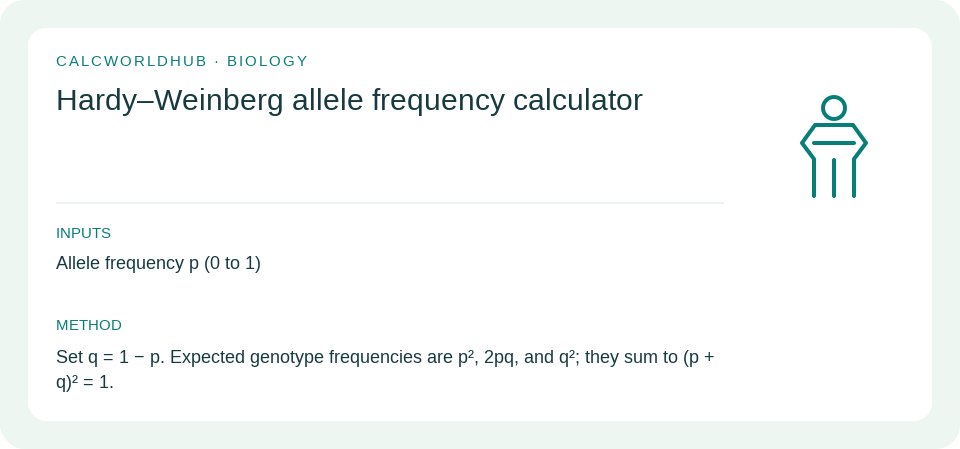
- Allele frequency p (0 to 1): Enter one allele’s frequency as a fraction; the other frequency is q = 1 − p.
Formula and method
Set q = 1 − p. Expected genotype frequencies are p², 2pq, and q²; they sum to (p + q)² = 1.
Worked example
With p = 0.70, q = 0.30. The expected frequencies are p² = 0.49, 2pq = 0.42, and q² = 0.09.
Interpreting the result
The calculator returns expected proportions under the model. Multiplying them by a population count would give expected counts before sampling variation.
Assumptions and limits
These are model expectations, not observations or a diagnosis of a population. Hardy–Weinberg assumptions include random mating and no substantial selection, migration, mutation, or drift for the locus and population considered.
Method references
Frequently asked questions
Do the three genotype frequencies have to sum to one?
Yes, because p² + 2pq + q² = (p + q)² and p + q = 1.
Does an expected heterozygote frequency prove equilibrium?
No. A sample must be compared with the expectation, with appropriate attention to sample size, design, and population assumptions.
How do I use the Hardy–Weinberg allele frequency calculator?
Enter Allele frequency p (0 to 1). Match the units shown beside each field and review the result together with the assumptions below.
What is a worked example of Hardy–Weinberg allele frequency?
With p = 0.70, q = 0.30. The expected frequencies are p² = 0.49, 2pq = 0.42, and q² = 0.09.
What does the Hardy–Weinberg allele frequency calculator calculate?
Estimate Hardy–Weinberg genotype frequencies p², 2pq, and q² from one allele frequency.
Good calculators show their work.
CalcWorldHub is built around clear inputs and visible assumptions. Results are estimates for planning; check official sources or your provider’s terms when exact figures matter.