Recessive allele frequency from genotype counts calculator
Estimate the recessive-allele frequency directly from observed genotype counts.
Related calculators and articles
Compare methods and explore more free tools in biology.
How to use this calculator
Estimate the recessive-allele frequency directly from observed genotype counts.
- Enter Homozygous recessive count, Heterozygote count, Homozygous dominant count. Match the units shown beside each field and review the result together with the assumptions below.
- Read the worked example below to check the expected input format and result.
- Compare another scenario by changing one input at a time. Use Reset to return to the starting values.
Recessive allele frequency from genotype counts calculator
Estimate the recessive-allele frequency directly from observed genotype counts.
Inputs and units
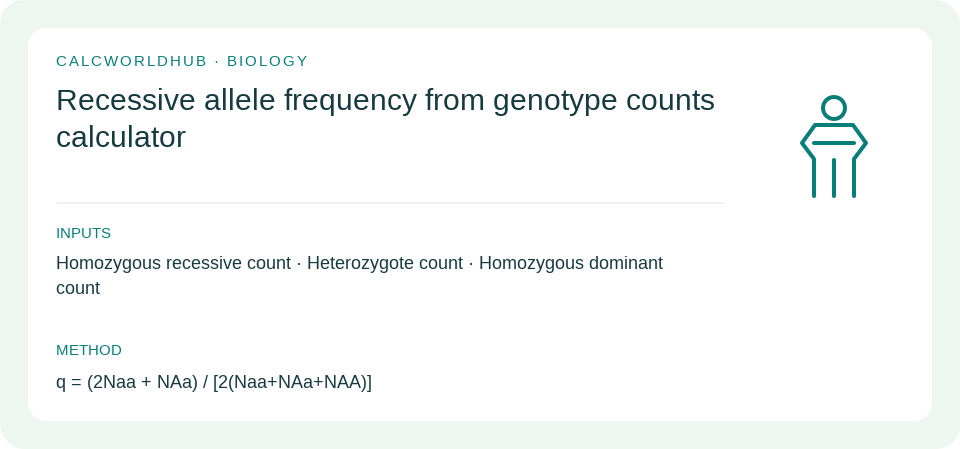
- Homozygous recessive count: Count of individuals with two recessive alleles; each contributes two copies to the recessive-allele numerator.
- Heterozygote count: Count of individuals with one recessive and one dominant allele; each contributes one recessive copy.
- Homozygous dominant count: Count of individuals with two dominant alleles; these contribute to the population denominator but not recessive copies.
Formula and method
q = (2Naa + NAa) / [2(Naa+NAa+NAA)]
Worked example
Counts 18 aa, 44 Aa, and 38 AA give q=(36+44)/(2·100)=0.40.
Interpreting the result
The result counts two recessive alleles per aa individual and one per heterozygote; it is an observed allele frequency, not a Hardy–Weinberg test.
Assumptions and limits
Counts must be nonnegative whole numbers and total individuals positive. Sampling uncertainty and population structure are not modeled.
Sources and method
- Explains allele and genotype frequencies in the Hardy–Weinberg framework; the observed-count estimate is independently derived from allele copies. OpenStax Biology 2e: population evolution
Frequently asked questions
What does this recessive allele frequency from genotype counts result tell me?
The result counts two recessive alleles per aa individual and one per heterozygote; it is an observed allele frequency, not a Hardy–Weinberg test.
What assumptions should I check?
Counts must be nonnegative whole numbers and total individuals positive. Sampling uncertainty and population structure are not modeled.
How do I use the Recessive allele frequency from genotype counts calculator?
Enter Homozygous recessive count, Heterozygote count, Homozygous dominant count. Match the units shown beside each field and review the result together with the assumptions below.
What is a worked example of Recessive allele frequency from genotype counts?
Counts 18 aa, 44 Aa, and 38 AA give q=(36+44)/(2·100)=0.40.
What does the Recessive allele frequency from genotype counts calculator calculate?
Estimate the recessive-allele frequency directly from observed genotype counts.
See the calculation methodology.