How to use this calculator
Combine measured harmonic amplitudes into a total-harmonic-distortion ratio.
- Enter Fundamental RMS amplitude, Higher harmonic RMS amplitudes. Match the units shown beside each field and review the result together with the assumptions below.
- Read the worked example below to check the expected input format and result.
- Compare another scenario by changing one input at a time. Use Reset to return to the starting values.
Harmonic amplitude total distortion explained
Combine measured harmonic amplitudes into a total-harmonic-distortion ratio.
How the calculation works
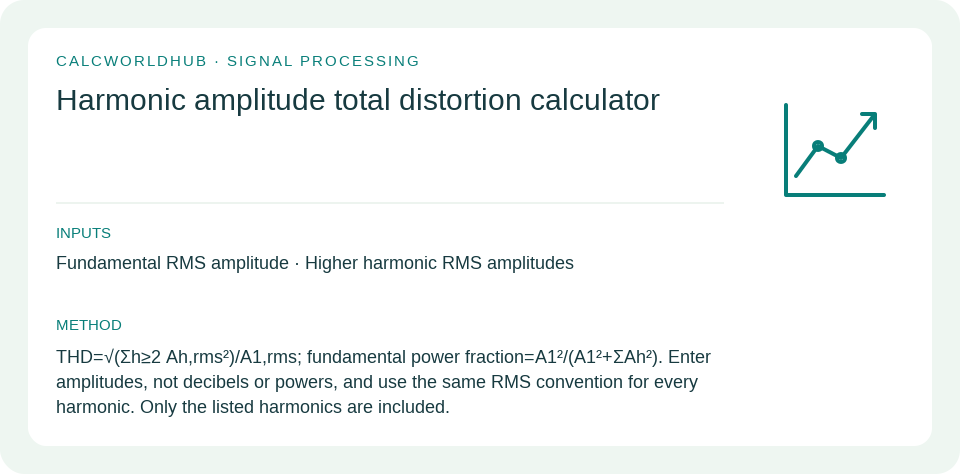
THD=√(Σh≥2 Ah,rms²)/A1,rms; fundamental power fraction=A1²/(A1²+ΣAh²).
Enter amplitudes, not decibels or powers, and use the same RMS convention for every harmonic. Only the listed harmonics are included.
Set up the calculation
fund— Fundamental RMS amplitude- Strictly positive RMS magnitude of the fundamental.
harm— Higher harmonic RMS amplitudes- Nonnegative RMS magnitudes for the measured higher harmonics. Use comma-separated values in the stated order.
Limits of this model
No broadband noise, intermodulation products or unmeasured harmonics.
Check this example
Fundamental RMS amplitude = 1; Higher harmonic RMS amplitudes = [0.05, 0.02, 0.01].
- Total harmonic distortion: 5.477226 %
- Combined harmonic RMS: 0.054772 signal units
- Fundamental share of measured power: 0.997009 ratio
A one-unit fundamental with harmonic RMS levels 0.05, 0.02 and 0.01 has measurable distortion even without broadband noise.
Reading the outputs
THD is percent relative to the fundamental, while the power fraction is relative to the total listed harmonic-plus-fundamental energy.
Frequently asked questions
Can THD exceed 100 percent?
Yes; combined harmonic RMS can exceed the fundamental.
Can peak sine amplitudes be used instead?
Ratios agree if every component uses the same peak convention, but the labeled RMS output would then be peak.
Is this THD+N?
No. Broadband noise is excluded.
How do I use the Harmonic amplitude total distortion calculator?
Enter Fundamental RMS amplitude, Higher harmonic RMS amplitudes. Match the units shown beside each field and review the result together with the assumptions below.
What is a worked example of Harmonic amplitude total distortion?
Fundamental RMS amplitude = 1; Higher harmonic RMS amplitudes = [0.05, 0.02, 0.01]. Total harmonic distortion: 5.477226 % Combined harmonic RMS: 0.054772 signal units Fundamental share of measured power: 0.997009 ratio A one-unit fundamental with harmonic RMS levels 0.05, 0.02 and 0.01 has measurable distortion even without broadband noise.
Read our calculation methodology.