How to use this calculator
Convert measured fundamental and residual levels into SINAD and a sine-equivalent effective bit count.
- Enter Fundamental RMS amplitude, Nonfundamental residual RMS. Match the units shown beside each field and review the result together with the assumptions below.
- Read the worked example below to check the expected input format and result.
- Compare another scenario by changing one input at a time. Use Reset to return to the starting values.
Measured SINAD and effective bit depth explained
Use Fundamental RMS amplitude with Nonfundamental residual RMS to reproduce the sample calculation, then review the stated limits before carrying the result into another scenario.
A numerical walkthrough
Fundamental RMS amplitude = 1; Nonfundamental residual RMS = 0.001.
- Measured SINAD: 60 dB
- Sine-equivalent effective bits: 9.673303 bits
- Residual-to-signal power: 0.000001 ratio
A one-unit RMS sine with 0.001-unit residual gives a 60 dB measured SINAD.
The model behind the numbers
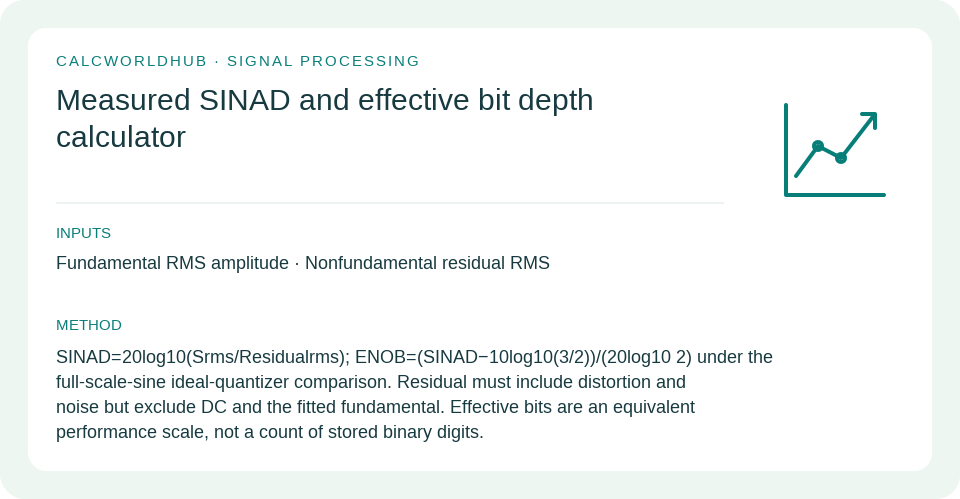
SINAD=20log10(Srms/Residualrms); ENOB=(SINAD−10log10(3/2))/(20log10 2) under the full-scale-sine ideal-quantizer comparison.
Residual must include distortion and noise but exclude DC and the fitted fundamental. Effective bits are an equivalent performance scale, not a count of stored binary digits.
What to enter
signal— Fundamental RMS amplitude- Positive fitted fundamental RMS amplitude.
noise— Nonfundamental residual RMS- Positive RMS of combined noise and distortion after removing DC and the fundamental.
Interpreting the result
The ENOB comparison assumes a full-scale sine; underfilled range and measurement bandwidth change interpretation.
Reading the outputs
Residual-to-signal power is a linear ratio; negative ENOB is possible for very poor residual performance.
Frequently asked questions
Is this the ideal ADC formula?
No. It starts from measured residual level instead of nominal resolution.
Can ENOB be fractional?
Yes. It is a continuous performance metric.
Should DC be included as noise?
Normally remove DC before measuring this residual.
How do I use the Measured SINAD and effective bit depth calculator?
Enter Fundamental RMS amplitude, Nonfundamental residual RMS. Match the units shown beside each field and review the result together with the assumptions below.
What is a worked example of Measured SINAD and effective bit depth?
Fundamental RMS amplitude = 1; Nonfundamental residual RMS = 0.001. Measured SINAD: 60 dB Sine-equivalent effective bits: 9.673303 bits Residual-to-signal power: 0.000001 ratio A one-unit RMS sine with 0.001-unit residual gives a 60 dB measured SINAD.
Read our calculation methodology.