Heart rate zones calculator
Estimate five rough heart-rate-reserve bands from age and a resting pulse.
inputs.
Calculator
How to use this calculator
Estimate five heart-rate-reserve training bands from age and resting heart rate; values are approximate, not medical guidance.
- Enter Age (years), Resting heart rate (bpm). Match the units shown beside each field and review the result together with the assumptions below.
- Read the worked example below to check the expected input format and result.
- Compare another scenario by changing one input at a time. Use Reset to return to the starting values.
Estimate five training bands from an age-based maximum and resting pulse
This calculator first estimates maximum heart rate as 220 minus age, then divides heart-rate reserve into five bands. The age-based maximum is a rough population estimate, not a measured personal maximum.
Inputs and units
- Age (years): Age used in the 220 − age estimate of maximum heart rate.
- Resting heart rate (bpm): Beats per minute measured while at rest; it anchors the lower end of heart-rate reserve.
Formula and method
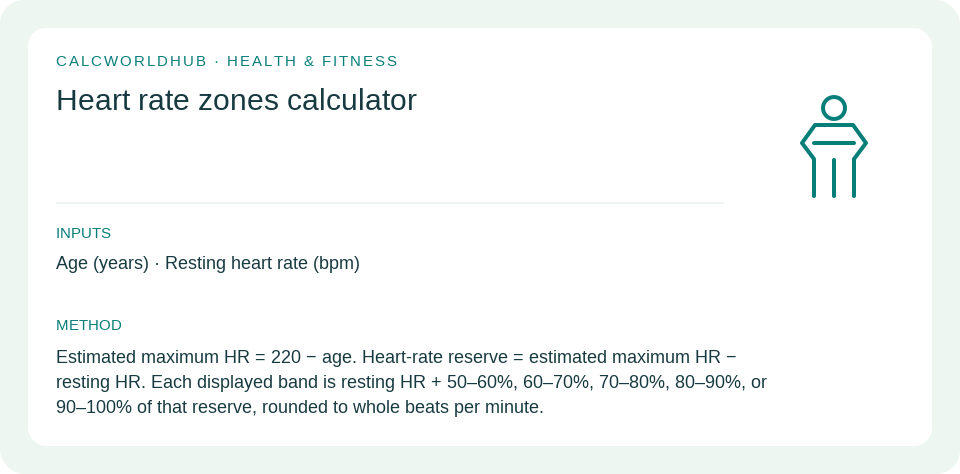
Estimated maximum HR = 220 − age. Heart-rate reserve = estimated maximum HR − resting HR. Each displayed band is resting HR + 50–60%, 60–70%, 70–80%, 80–90%, or 90–100% of that reserve, rounded to whole beats per minute.
Worked example
At age 30 with resting HR 65 bpm, estimated maximum HR is 190 and reserve is 125 bpm. Zone 1 is 65 + 50–60% × 125 = 127.5–140 bpm, displayed as 128–140 bpm; the remaining bands use the same 10-point steps.
Interpreting the result
These are the calculator’s five heart-rate-reserve bands. They can help organize training effort, but the result is not a medical assessment or a personalized exercise prescription.
Assumptions and limits
The 220 − age estimate can differ substantially from an individual’s measured maximum. Medications, fitness, illness, temperature, and measurement error affect heart rate. The five reserve bands shown here are not the same definition as every organization’s moderate or vigorous target zone; use clinical guidance when a health condition or medication affects exercise.
Method references
Frequently asked questions
Are these the American Heart Association’s moderate and vigorous zones?
Not exactly. This tool divides heart-rate reserve into five 10-point bands. AHA guidance commonly describes moderate and vigorous targets as percentages of age-predicted maximum heart rate; those are different calculations.
How do I use the Heart rate zones calculator?
Enter Age (years), Resting heart rate (bpm). Match the units shown beside each field and review the result together with the assumptions below.
What is a worked example of Heart rate zones?
At age 30 with resting HR 65 bpm, estimated maximum HR is 190 and reserve is 125 bpm. Zone 1 is 65 + 50–60% × 125 = 127.5–140 bpm, displayed as 128–140 bpm; the remaining bands use the same 10-point steps.
What does the Heart rate zones calculator calculate?
Estimate five heart-rate-reserve training bands from age and resting heart rate; values are approximate, not medical guidance.
What assumptions apply to Heart rate zones?
The 220 − age estimate can differ substantially from an individual’s measured maximum. Medications, fitness, illness, temperature, and measurement error affect heart rate. The five reserve bands shown here are not the same definition as every organization’s moderate or vigorous target zone; use clinical guidance when a health condition or medication affects exercise.
Good calculators show their work.
CalcWorldHub is built around clear inputs and visible assumptions. Results are estimates for planning; check official sources or your provider’s terms when exact figures matter.