Target heart rate zone calculator
This is a rough age-based estimate, not an individualized exercise prescription. Enter the intensity range you want to examine.
Calculator
How to use this calculator
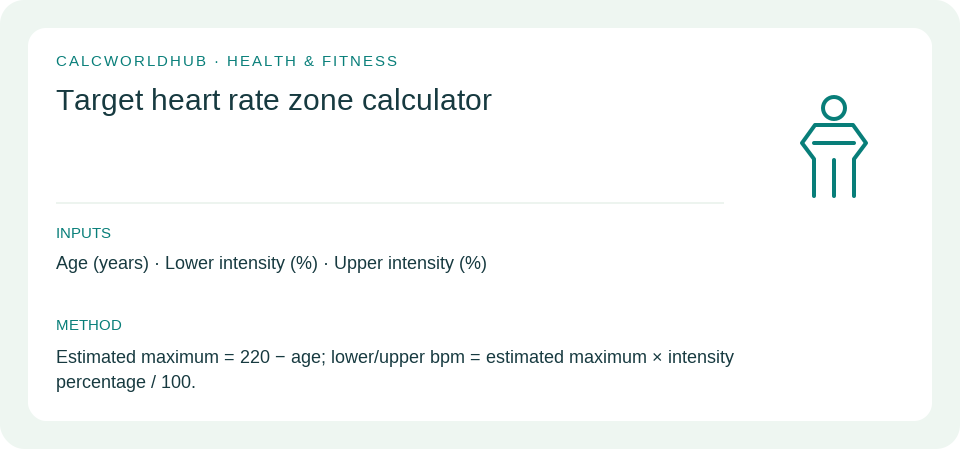
Estimate a broad exercise heart-rate range from age and user-selected intensity percentages.
- Enter Age (years), Lower intensity (%), Upper intensity (%). Match the units shown beside each field and review the result together with the assumptions below.
- Read the worked example below to check the expected input format and result.
- Compare another scenario by changing one input at a time. Use Reset to return to the starting values.
Target heart rate zone calculator
This is a rough age-based estimate, not an individualized exercise prescription. Enter the intensity range you want to examine.
What it measures
The calculator estimates maximum heart rate as 220 minus age and multiplies it by the lower and upper intensity percentages.
Inputs and units
- Age (years): Age in years; the simple 220−age estimate must remain positive.
- Lower intensity (%): Lower intensity as a percentage of estimated maximum.
- Upper intensity (%): Upper intensity as a percentage; it must be at least the lower value and no more than 100%.
Formula and method
Estimated maximum = 220 − age; lower/upper bpm = estimated maximum × intensity percentage / 100.
Worked example
At age 35, the estimate is 185 bpm. A selected 60–75% range gives about 111–139 bpm.
Interpreting the result
The output is a broad bpm estimate. It is not a measured maximum, training threshold, or guarantee of safe effort.
Assumptions and limits
The 220−age rule is an approximate population guide. Medication, health conditions, fitness, and individual variation can change appropriate targets; consult a health professional when relevant.
Sources and method
- Describes 220−age as an approximate maximum-heart-rate estimate and says target zones are general averages. American Heart Association: Target heart rates chart
Frequently asked questions
Is 220 minus age an exact maximum?
No. It is an approximate estimate; individual maximum heart rates vary.
Should I use this target if I take medication?
Medication can change heart-rate response; ask a healthcare professional for an appropriate target.
How do I use the Target heart rate zone calculator?
Enter Age (years), Lower intensity (%), Upper intensity (%). Match the units shown beside each field and review the result together with the assumptions below.
What is a worked example of Target heart rate zone?
At age 35, the estimate is 185 bpm. A selected 60–75% range gives about 111–139 bpm.
What does the Target heart rate zone calculator calculate?
Estimate a broad exercise heart-rate range from age and user-selected intensity percentages.
See the calculation methodology.
Good calculators show their work.
CalcWorldHub is built around clear inputs and visible assumptions. Results are estimates for planning; check official sources or your provider’s terms when exact figures matter.