How to use this calculator
Calculate liquid volume and percent full in a level, flat-ended horizontal tank from inside diameter, shell length, and fill depth.
- Enter Tank inside diameter, Straight shell length, Liquid depth from the tank bottom. Match the units shown beside each field and review the result together with the assumptions below.
- Read the worked example below to check the expected input format and result.
- Compare another scenario by changing one input at a time. Use Reset to return to the starting values.
How this calculation works
Enter the inside diameter and straight cylindrical shell length, then the liquid depth measured vertically from the inside bottom. The filled cross-section is a circular segment, so volume does not increase linearly with depth. Keep all three dimensions in one consistent length unit.
Inputs and units
insideDiameter— Tank inside diameter- Measure the inside diameter of the straight cylindrical shell, not its outside diameter.
barrelLength— Straight shell length- Use the length of the cylindrical barrel only; do not include end caps.
fillDepth— Liquid depth from the tank bottom- Measure vertically from the inside bottom to the liquid surface. Must be between 0 and the inside diameter.
Formula
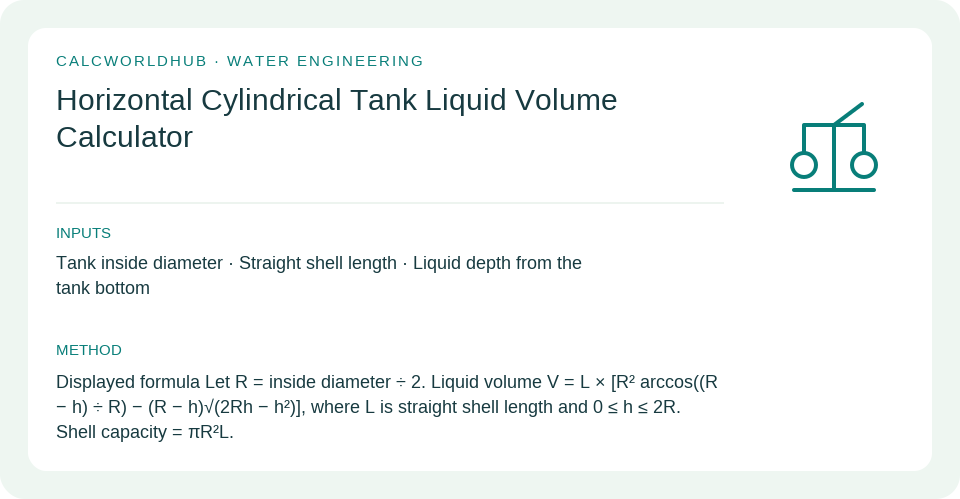
Let R = inside diameter ÷ 2. Liquid volume V = L × [R² arccos((R − h) ÷ R) − (R − h)√(2Rh − h²)], where L is straight shell length and 0 ≤ h ≤ 2R. Shell capacity = πR²L.
Method
Compute the circular-segment area below the liquid surface using the radius and fill depth, then multiply by the straight barrel length. Divide by the full cylindrical-shell capacity to calculate percent full. The inverse cosine uses radians internally.
Worked example
For a level tank with a 2 m inside diameter, a 5 m straight shell, and a 1 m liquid depth, the shell is half full: 7.854 m³ of liquid in a 15.708 m³ shell capacity.
Assumptions and limits
Assumes a horizontal, level cylinder with a constant circular inside diameter and flat ends. It covers only the straight shell, excluding dished heads, piping, fittings, sediment, and internal structures. Tilted or non-circular tanks need a calibrated strapping table or geometry-specific model; use inside dimensions for inventory estimates.
Frequently asked questions
Why is volume not proportional to fill depth?
The circular cross-section is narrow near the bottom and top and widest at the center. Equal depth changes therefore add different cross-sectional areas.
What should I measure as tank length?
Use only the straight cylindrical barrel length. This formula does not include domed, dished, or elliptical end heads.
Which diameter should I enter?
Use the inside diameter because liquid occupies the interior shell. An outside diameter overstates the liquid capacity.
Can I use this for a tilted tank?
No. The equation assumes a level tank whose axis is horizontal. Tilt, irregular geometry, internal fittings, and head shapes require a calibrated table or another model.
How do I use the Horizontal Cylindrical Tank Liquid Volume Calculator?
Enter Tank inside diameter, Straight shell length, Liquid depth from the tank bottom. Match the units shown beside each field and review the result together with the assumptions below.
Reference: Wolfram MathWorld circular-segment volume formula for a horizontal cylindrical shell. See our calculation methodology.