How to use this calculator
Adjust a radiator’s rated output for water flow, return, room temperature, and its product-specific exponent.
- Enter Rated radiator output (W), Water inlet temperature (°C), Water return temperature (°C), Room air temperature (°C), then complete the remaining labeled fields. Match the units shown beside each field and review the result together with the assumptions below.
- Read the worked example below to check the expected input format and result.
- Compare another scenario by changing one input at a time. Use Reset to return to the starting values.
How this calculation works
A radiator’s delivered heat changes nonlinearly with the temperature difference between its water and the room. This estimate adjusts a manufacturer’s rated output with a power law. It uses the arithmetic mean water temperature when the return-to-inlet excess-temperature ratio is at least 0.7 and a logarithmic mean below that threshold.
Inputs and units
ratedOutputW— Rated radiator output (W)- Enter manufacturer-rated output at the stated reference temperature difference.
flowTempC— Water inlet temperature (°C)- Enter water temperature entering the radiator.
returnTempC— Water return temperature (°C)- Enter water temperature leaving the radiator.
roomTempC— Room air temperature (°C)- Enter room air temperature near the emitter.
ratedDeltaK— Rated water-to-room difference ΔT_rated (K)- Use the reference difference for the manufacturer’s rated output; EN 442 products commonly use 50 K.
exponent— Emitter exponent n- Use the product-specific exponent from the radiator data sheet.
Formula
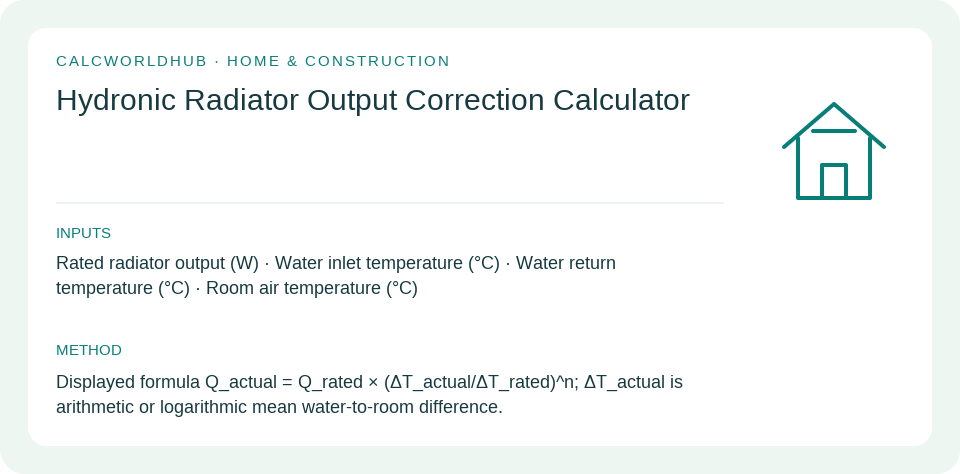
Q_actual = Q_rated × (ΔT_actual/ΔT_rated)^n; ΔT_actual is arithmetic or logarithmic mean water-to-room difference.
Method
Compute the inlet and return excess temperatures above room temperature. If their ratio is at least 0.7, use their arithmetic mean; otherwise use the log-mean temperature difference. Scale rated output by the ratio of actual to rated ΔT raised to the manufacturer’s exponent n.
Worked example
For a 2,000 W radiator rated at ΔT = 50 K, with 45°C inlet, 35°C return, 20°C room, and n = 1.3, the effective ΔT is 19.58 K and estimated output is 591 W.
For a 2,000 W radiator rated at ΔT = 50 K, use 45°C inlet, 40°C return, 20°C room, and n = 1.3. The return-to-inlet excess-temperature ratio is 20 ÷ 25 = 0.80, so this case uses the arithmetic mean ΔT of 22.5 K and estimates about 708 W.
Assumptions and limits
Use the exponent, reference ΔT, and rated output from the radiator’s own data sheet. The estimate does not model water-flow limits, room heat loss, control valves, installation effects, or the building’s full heating balance.
Frequently asked questions
Where can I find the radiator exponent?
Use the exponent and reference rating supplied by the radiator manufacturer; products can differ.
Why use a logarithmic mean at low return-temperature ratios?
It better represents the water-to-room temperature difference along the emitter when water cools substantially through it.
Is the corrected output the room’s required heating load?
No. It estimates emitter output under entered temperatures; a room heat-loss calculation is a separate task.
How do I use the Hydronic Radiator Output Correction Calculator?
Enter Rated radiator output (W), Water inlet temperature (°C), Water return temperature (°C), Room air temperature (°C), then complete the remaining labeled fields. Match the units shown beside each field and review the result together with the assumptions below.
What is a worked example of Hydronic Radiator Output Correction?
For a 2,000 W radiator rated at ΔT = 50 K, with 45°C inlet, 35°C return, 20°C room, and n = 1.3, the effective ΔT is 19.58 K and estimated output is 591 W. For a 2,000 W radiator rated at ΔT = 50 K, use 45°C inlet, 40°C return, 20°C room, and n = 1.3. The return-to-inlet excess-temperature ratio is 20 ÷ 25 = 0.80, so this case uses the arithmetic mean ΔT of 22.5 K and estimates about 708 W.
Reference: Caleffi hydronic design appendix explaining radiator output correction and mean water-to-room temperature difference. See our calculation methodology.