How to use this calculator
Compare indoor dew point with a window’s interior surface temperature to estimate condensation margin.
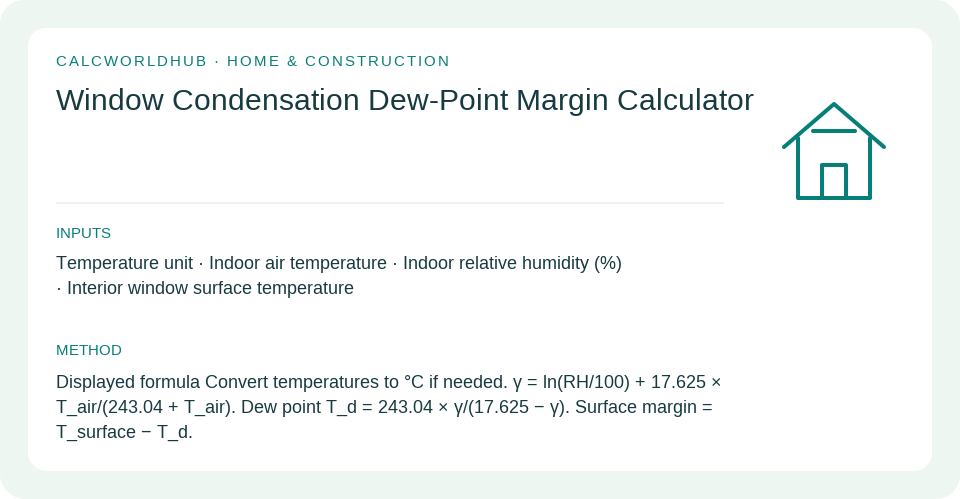
- Enter Temperature unit, Indoor air temperature, Indoor relative humidity (%), Interior window surface temperature. Match the units shown beside each field and review the result together with the assumptions below.
- Read the worked example below to check the expected input format and result.
- Compare another scenario by changing one input at a time. Use Reset to return to the starting values.
How this calculation works
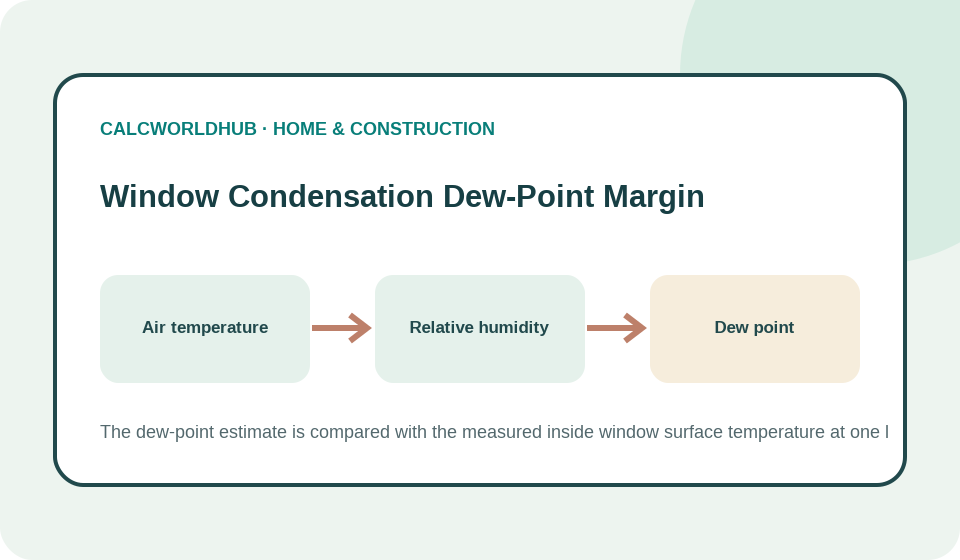
Condensation becomes possible when moist indoor air meets a surface at or below the air’s dew point. Enter indoor air temperature and relative humidity along with a measured window-surface temperature; the result reports the estimated dew point and how many degrees the surface is above or below it.
Inputs and units
temperatureUnit— Temperature unit- Choose the unit used for both temperature readings and the reported margin.
airTemperature— Indoor air temperature- Measured room-air temperature near the window, in the selected unit.
relativeHumidityPct— Indoor relative humidity (%)- Relative humidity measured near the window; must be above 0% and at most 100%.
surfaceTemperature— Interior window surface temperature- Temperature of the glass or frame surface where condensation is being checked.
Formula
Convert temperatures to °C if needed. γ = ln(RH/100) + 17.625 × T_air/(243.04 + T_air). Dew point T_d = 243.04 × γ/(17.625 − γ). Surface margin = T_surface − T_d.
Method
The dew-point estimate uses a Magnus-type empirical approximation over liquid water. A positive surface margin is above the estimated dew point; zero or a negative margin means the entered surface temperature reaches or falls below that point.
Worked example
At 20 °C and 50% relative humidity, the approximation gives a dew point of about 9.3 °C. A 12 °C interior glass surface is therefore about 2.7 °C above the estimated dew point.
Assumptions and limits
This is a screening estimate for one measured surface location, not a building moisture assessment. Air mixing, local humidity, sensor accuracy, thermal bridges, surface films, and short-term temperature changes matter. EPA guidance explains that condensation forms when moist air cools to its dew point and recommends addressing moisture sources and cold surfaces.
Frequently asked questions
What does a negative surface margin mean?
It means the entered surface temperature is below the estimated dew point, so condensation is thermodynamically possible at that location if the nearby air has the entered moisture content.
Should I measure the glass or the room air?
Measure both. Use a surface probe or a suitable infrared thermometer for the glass and a separate temperature-humidity sensor near the window; avoid readings in direct sunlight or on a different surface.
Does a positive margin guarantee no condensation?
No. Conditions and measurement errors vary across the window, and temperatures or humidity can change. Treat this as a point-in-time screen, not a guarantee.
Why does the calculator offer Celsius and Fahrenheit?
The calculation is performed in Celsius and the temperature difference is converted back to the selected unit for display. A degree difference has the same numeric size as a Celsius difference only in Celsius; Fahrenheit margins are converted correctly.
How do I use the Window Condensation Dew-Point Margin Calculator?
Enter Temperature unit, Indoor air temperature, Indoor relative humidity (%), Interior window surface temperature. Match the units shown beside each field and review the result together with the assumptions below.
Reference: U.S. EPA public water-system planning guidance. See our calculation methodology.