
Take measurements at the same time and place
Record indoor air temperature and relative humidity near the window, then measure the interior surface temperature at the spot where moisture is suspected. Avoid placing the air sensor against the glass or directly in a supply-air stream. A reading from the center of one pane may differ from the edge, frame, spacer, or another window in the room.
Temperature units must be consistent within the selected setting. The calculator can accept Celsius or Fahrenheit and converts internally before applying its dew-point approximation. Relative humidity is entered as a percent, such as 55 for 55%, not as a decimal fraction. The supported humidity range excludes zero because the logarithm of zero is undefined.
Understand the dew-point approximation
The calculation uses a Magnus-form relation. With temperature in degrees Celsius, γ = ln(RH/100) + 17.625 × T_air/(243.04 + T_air), and dew point = 243.04 × γ/(17.625 − γ). The constants are an empirical approximation; the tool reports a calculated estimate, not a chilled-mirror measurement or a complete psychrometric analysis.
The National Weather Service describes dew point as the temperature air must reach, at constant pressure, to become saturated. When a surface is colder than the surrounding air’s dew point, water can condense there. The model turns that comparison into a signed margin: interior surface temperature minus calculated dew point.
Worked examples
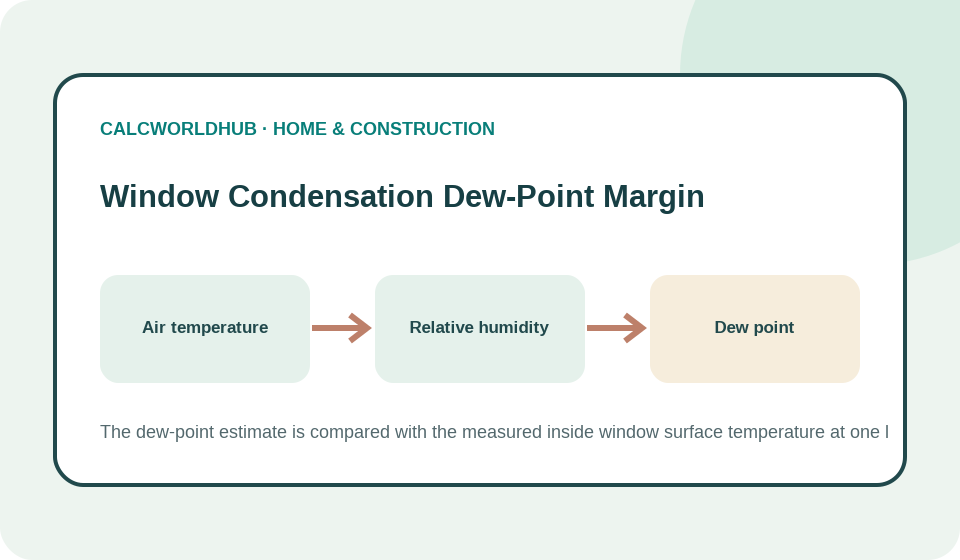
The dew point is estimated from air temperature and relative humidity, then compared with the measured interior surface temperature.
The measured pane is slightly above dew point
Inputs: Indoor air = 22°C; relative humidity = 50%; interior glass surface = 12°C.
Calculation: γ = ln(0.50) + 17.625 × 22 ÷ (243.04 + 22) ≈ 0.769; dew point ≈ 11.10°C; margin = 12 − 11.10 ≈ +0.90°C.
The measured surface is about 0.90°C above the estimated dew point at this reading.
The glass is slightly below the estimated dew point
Inputs: Indoor air = 20°C; relative humidity = 65%; interior glass surface = 13°C.
Calculation: γ = ln(0.65) + 17.625 × 20 ÷ (243.04 + 20) ≈ 0.909; dew point ≈ 13.22°C; margin = 13 − 13.22 ≈ −0.22°C.
The negative margin flags condensation-favorable conditions at the measured surface point.

Read a positive or negative margin
A positive margin means the measured surface is warmer than the estimated dew point at that moment. A value near zero is a narrow buffer: ordinary changes in outdoor weather, indoor moisture, curtains, or sensor placement can remove it. A negative margin means the measured surface is below the estimated dew point, so the conditions support condensation at that location.
The sign is a screening result, not a promise that visible droplets will or will not appear. Surface temperature and humidity vary over time, and real condensation also depends on local air movement and the actual temperature of the coldest point. Repeat readings during the conditions that produce moisture and compare the same locations consistently.
Use the result to guide observation
If the margin is small or negative, inspect the glass edges, frame, sill, and nearby wall for water, staining, or recurring dampness. Check whether indoor humidity is elevated and whether ventilation or moisture sources are contributing. EPA moisture-control guidance emphasizes reducing moisture and addressing sources rather than treating a single surface reading as the whole diagnosis.
Do not use one favorable reading to rule out hidden moisture, leaks, or mold. A window can warm after sunlight reaches it, while a nearby frame remains colder. Conversely, condensation may be intermittent and disappear before you take a measurement. Keep a short log of air temperature, RH, surface spot, time, and weather to understand patterns.
Know where the model stops
This tool models one air condition and one interior surface. It does not map thermal bridges, estimate indoor moisture generation, calculate ventilation needs, predict mold growth, or diagnose a failed window seal. The input range is broad for numeric handling, but the Magnus constants are an approximation and should not be treated as equally accurate for every extreme temperature or humidity condition.
For persistent wetting, damaged finishes, or suspected building-envelope problems, a qualified building-science or moisture professional can inspect more than one surface and examine airflow, insulation, drainage, and ventilation. Use the calculated margin as a clearly stated comparison of measured values, not as a safety certification or a substitute for investigating repeated moisture.