
Measure the room and choose relevant CADR
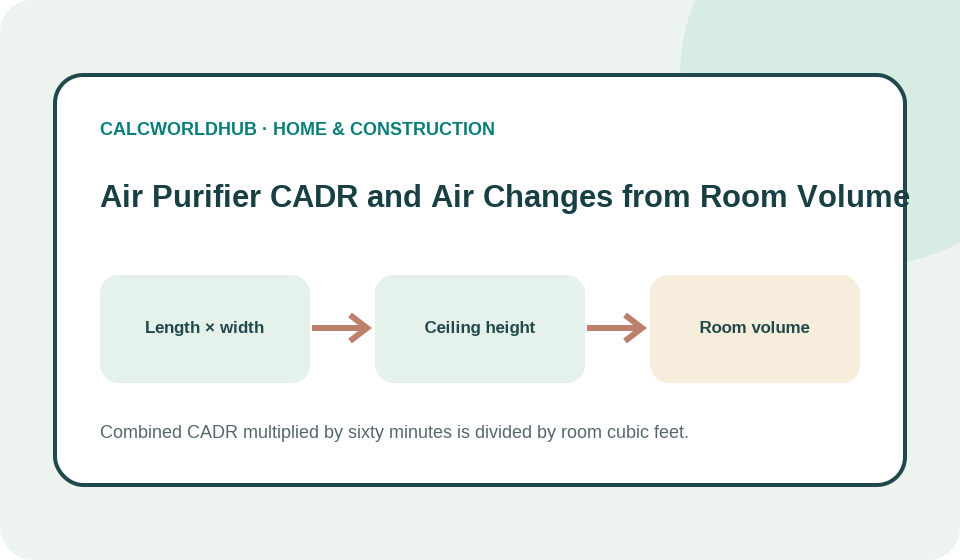
Enter clear room length, width, and average ceiling height in feet. Their product is room volume in cubic feet. Enter the purifier's CADR in cubic feet per minute and the number of identical units currently running. Use a CADR rating for the pollutant category relevant to your purpose; a smoke, dust, or pollen rating is not interchangeable with an unverified airflow claim.
EPA guidance recommends choosing a portable air cleaner with a CADR suitable for the room size. Placement, fan setting, filter condition, open doors, and room mixing affect delivered clean air. The calculator treats each unit as identical and operating at its entered CADR; it does not account for a low or quiet fan setting that reduces airflow.
Worked examples
The examples convert room dimensions to cubic feet before comparing current and target clean-air delivery.
Two units meet a five-change target in a 2,400 ft³ room
Inputs: Room = 20 ft × 15 ft × 8 ft; CADR per unit = 100 CFM; current units = 2; target = 5 clean-air changes/hour.
Calculation: Volume = 20 × 15 × 8 = 2,400 ft³; current ACH = (100 × 2 × 60) ÷ 2,400 = 5; required CADR = 2,400 × 5 ÷ 60 = 200 CFM; additional units = ceil(200 ÷ 100) − 2 = 0; shortfall = 0 CFM.
At the entered ratings, the two operating purifiers equal the 5-per-hour target. That is an arithmetic comparison and does not account for room mixing or filter condition.
One purifier falls short in a smaller room
Inputs: Room = 14 ft × 12 ft × 9 ft; CADR per unit = 80 CFM; current units = 1; target = 4.8 clean-air changes/hour.
Calculation: Volume = 14 × 12 × 9 = 1,512 ft³; current ACH = (80 × 60) ÷ 1,512 ≈ 3.17; required CADR = 1,512 × 4.8 ÷ 60 = 120.96 CFM; additional units = ceil(120.96 ÷ 80) − 1 = 1; shortfall = 120.96 − 80 = 40.96 CFM.
The current unit is below the selected target. One additional identical unit is enough under the simplified model, bringing the entered total CADR to 160 CFM.

Equivalent clean-air changes per hour
Room volume = length × width × ceiling height. Current equivalent clean-air changes per hour = (CADR × unit count × 60) ÷ room volume. CADR in cubic feet per minute is multiplied by 60 minutes per hour to produce cubic feet per hour; dividing by room cubic feet leaves reciprocal hours. The number is an equivalent clean-air rate under the model, not a count of literal room air replacements.
Required total CADR for a target = room volume × target changes per hour ÷ 60. The calculator also estimates additional identical units by dividing required CADR by one unit's CADR, rounding that unit total up, and subtracting the number already present. A small shortfall can therefore still call for one full additional unit.
Choose the target for a defined purpose
Enter a positive target from applicable guidance or a stated planning objective. The calculator includes 4.8 clean-air changes per hour as a common AHAM rating basis for suggested room size, but that figure is not a universal health prescription. EPA guidance discusses CADR and room sizing; public-space ventilation guidance also distinguishes filtration from outdoor-air delivery.
Equivalent clean-air changes may combine filtered air with other clean-air contributions only in a broader model that defines those streams. This calculator includes the purifier CADR and unit count only. It does not add outdoor ventilation, HVAC filtration, deposition, or other air-cleaning processes, so do not call its output total ventilation unless those terms are separately accounted for.
Understand what particle CADR leaves out
EPA explains that portable air cleaners can reduce airborne particles, but particle filtration does not necessarily reduce gases, chemicals, and odors in the same way. This calculator uses CADR as one airflow figure and has no field for filter type, gas sorbent, room source strength, occupant activity, or contaminant concentration. It cannot predict a concentration or guarantee a health outcome.
Follow maintenance instructions and use a CADR rating at the fan setting you plan to run. Open doors and connected rooms can make this single-room volume inaccurate. The estimate does not model those factors.
Interpret unit count and shortfall
The output reports current equivalent clean-air changes, target total CADR, additional identical units, and the CADR shortfall at the current count. If the current units already exceed the target, the additional count and shortfall are zero. If their combined rating falls short, the unit estimate is rounded up because the model cannot add a fraction of an identical device.
Dimensions, CADR, and target must be positive; unit count must be a whole positive value. Although some field minimums show zero, the runtime rejects zero dimensions, CADR, and target. Do not count a disabled or unpowered device as operating.