Hypergeometric probability calculator
Calculate an exact count probability when sampling a finite population without replacement.
Calculator
How to use this calculator
Calculate an exact count probability when sampling a finite population without replacement.
- Enter Population size N, Successes K, Sample size n, Successes in sample k. Match the units shown beside each field and review the result together with the assumptions below.
- Read the worked example below to check the expected input format and result.
- Compare another scenario by changing one input at a time. Use Reset to return to the starting values.
Hypergeometric probability calculator
Calculate an exact count probability when sampling a finite population without replacement.
What it measures
The PMF counts ways to choose k marked items and n−k unmarked items, divided by all samples of size n.
Inputs and units
- Population size N: Population size N, a nonnegative safe whole number above zero.
- Successes K: Number of marked/success items K, from zero through N.
- Sample size n: Sample size n, from zero through N.
- Successes in sample k: Observed marked items k, feasible for both marked and unmarked counts.
Formula and method
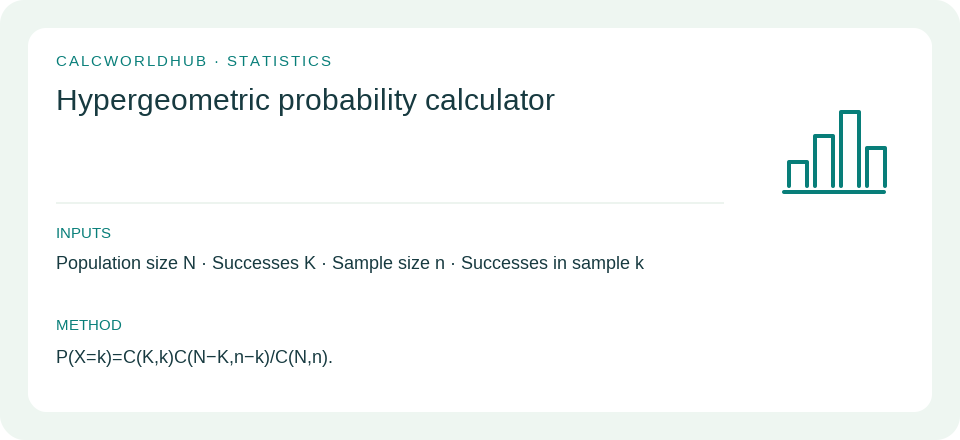
P(X=k)=C(K,k)C(N−K,n−k)/C(N,n).
Worked example
From N=20 with K=7 successes, a sample of n=5 has P(k=2)=C(7,2)C(13,3)/C(20,5)=0.3873839.
Interpreting the result
This is the probability of exactly two marked items in the sample, not at most two.
Assumptions and limits
Assumes simple random sampling without replacement and integer counts that satisfy population and sample bounds.
Sources and method
- Defines sampling marked items without replacement and the associated combinations. NIST Dataplot reference: Hypergeometric distribution
Frequently asked questions
Why not use the binomial distribution?
Without replacement, draws are dependent; the hypergeometric model accounts for a finite population.
Can the sample equal the whole population?
Yes; the probability is then determined by the population’s exact marked count.
How do I use the Hypergeometric probability calculator?
Enter Population size N, Successes K, Sample size n, Successes in sample k. Match the units shown beside each field and review the result together with the assumptions below.
What is a worked example of Hypergeometric probability?
From N=20 with K=7 successes, a sample of n=5 has P(k=2)=C(7,2)C(13,3)/C(20,5)=0.3873839.
What does the Hypergeometric probability calculator calculate?
Calculate an exact count probability when sampling a finite population without replacement.
See the calculation methodology.
Good calculators show their work.
CalcWorldHub is built around clear inputs and visible assumptions. Results are estimates for planning; check official sources or your provider’s terms when exact figures matter.