Hypergeometric sample size from expected successes calculator
Estimate the sample size needed for a target expected number of marked items when sampling without replacement. Enter your values below to see the result and method.
inputs.
Related calculators
These tools cover nearby questions while keeping this page focused on its own calculation.
How to use this calculator
Estimate the sample size needed for a target expected number of marked items when sampling without replacement.
- Enter Target expected marked items E[X], Population size N, Marked items K. Match the units shown beside each field and review the result together with the assumptions below.
- Read the worked example below to check the expected input format and result.
- Compare another scenario by changing one input at a time. Use Reset to return to the starting values.
Set the distribution and parameter convention
Estimate the sample size needed for a target expected number of marked items when sampling without replacement.
Inputs and units
Enter the values below for this model. Target expected marked count from 0 through K. The minimum integer sample is rounded upward to meet at least this expectation. Total number of distinct units in the finite population; N is a positive integer. Positive whole count of marked items in the finite population, with K ≤ N.
- Target expected marked items E[X]: Target expected marked count from 0 through K. The minimum integer sample is rounded upward to meet at least this expectation.
- Population size N: Total number of distinct units in the finite population; N is a positive integer.
- Marked items K: Positive whole count of marked items in the finite population, with K ≤ N.
Statistical formula and example
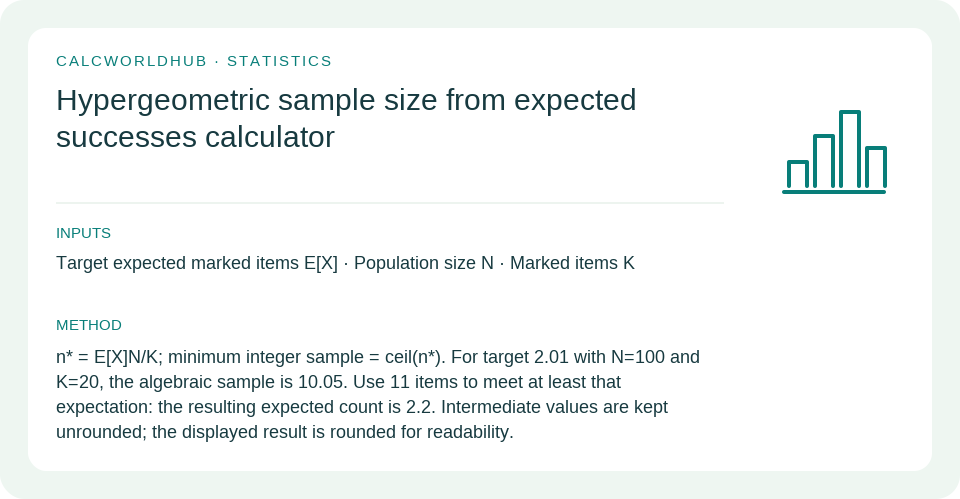
n* = E[X]N/K; minimum integer sample = ceil(n*).
For target 2.01 with N=100 and K=20, the algebraic sample is 10.05. Use 11 items to meet at least that expectation: the resulting expected count is 2.2.
Intermediate values are kept unrounded; the displayed result is rounded for readability.
Interpreting the statistic
The expected count nK/N grows linearly with sample size n; it is an average number of successes, not the probability of reaching a target count. This inversion assumes a simple random sample without replacement from N items containing exactly K successes.
Assumptions and limitations
Assumes simple random sampling without replacement, positive whole N and K with K ≤ N, and a target from 0 through K. The result rounds the algebraic inverse upward for an at-least expected-count target. It is not a confidence level or a probability guarantee.
Frequently asked questions
Why can solving for sample size produce a fractional number?
n* = E[X]N/K; minimum integer sample = ceil(n*). For target 2.01 with N=100 and K=20, the algebraic sample is 10.05. Use 11 items to meet at least that expectation: the resulting expected count is 2.2.
What conditions does the expected-success inversion assume?
It assumes simple random sampling without replacement with 1 ≤ K ≤ N and a target from 0 through K. Ceil(E[X]N/K) is the minimum integer sample meeting at least the target mean; it does not guarantee the realized success count.
How do I use the Hypergeometric sample size from expected successes calculator?
Enter Target expected marked items E[X], Population size N, Marked items K. Match the units shown beside each field and review the result together with the assumptions below.
What is a worked example of Hypergeometric sample size from expected successes?
n* = E[X]N/K; minimum integer sample = ceil(n*). For target 2.01 with N=100 and K=20, the algebraic sample is 10.05. Use 11 items to meet at least that expectation: the resulting expected count is 2.2. Intermediate values are kept unrounded; the displayed result is rounded for readability.
What does the Hypergeometric sample size from expected successes calculator calculate?
Estimate the sample size needed for a target expected number of marked items when sampling without replacement.
Read the calculation methodology and privacy policy.
Source: OpenStax Statistics 4.5: Hypergeometric Distribution.