Hypergeometric variance calculator
Measure the spread of marked-item counts in sampling without replacement. Enter your values below to see the result and method.
inputs.
Related calculators
These tools cover nearby questions while keeping this page focused on its own calculation.
How to use this calculator
Free Hypergeometric variance calculator. Measure the spread of marked-item counts in sampling without replacement. Formula, example, and assumptions explained.
- Enter Population size N, Marked items K, Sample size n. Match the units shown beside each field and review the result together with the assumptions below.
- Read the worked example below to check the expected input format and result.
- Compare another scenario by changing one input at a time. Use Reset to return to the starting values.
Set the distribution and parameter convention
Measure the spread of marked-item counts in sampling without replacement.
Inputs and units
Use the units printed beside each field. These values are Population size N, Marked items K, Sample size n.
- Population size N: Total number of items in the finite population before sampling.
- Marked items K: Number of the N items with the property counted as a success.
- Sample size n: Number drawn without replacement; it cannot exceed N.
Statistical formula and example
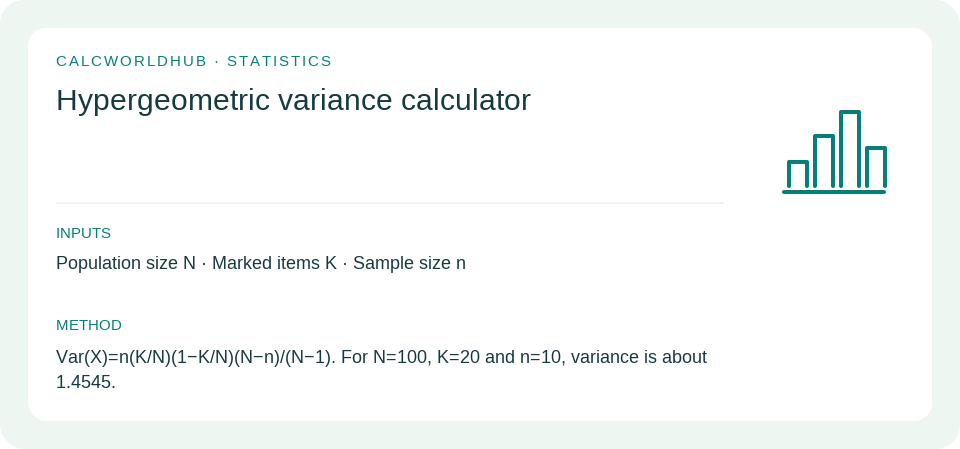
Var(X)=n(K/N)(1−K/N)(N−n)/(N−1).
For N=100, K=20 and n=10, variance is about 1.4545.
Interpreting the statistic
The variance describes spread in marked-item counts across repeated samples drawn without replacement; its units are squared counts, not a single-sample prediction.
Assumptions and limitations
Requires N>1 and a simple random sample without replacement; variance is in squared count units.
Method reference: Penn State STAT 414, The Hypergeometric Distribution.
Frequently asked questions
What does this distribution parameter mean?
It is the hypergeometric variance under the stated model. Inputs are Population size N, Marked items K, Sample size n.
Can I apply this result to any dataset?
Only if the model assumptions fit the data. Requires N>1 and a simple random sample without replacement; variance is in squared count units.
When do I need expected successes instead of their variance?
Expected successes nK/N gives the mean count. This page measures spread around that mean and includes the finite-population correction for sampling without replacement.
How do I use the Hypergeometric variance calculator?
Enter Population size N, Marked items K, Sample size n. Match the units shown beside each field and review the result together with the assumptions below.
What is a worked example of Hypergeometric variance?
Var(X)=n(K/N)(1−K/N)(N−n)/(N−1). For N=100, K=20 and n=10, variance is about 1.4545.
Read the calculation methodology and privacy policy.