Hypergeometric success-count standard deviation calculator
Express the spread of a without-replacement marked-item count in its original count units. Enter the values below to see the result and method.
inputs.
Related calculators
These tools cover the mean, variance, spread, and individual probabilities for finite sampling without replacement.
How to use this calculator
Express the spread of a without-replacement marked-item count in its original count units.
- Enter Population size N, Marked items K, Draws n. Match the units shown beside each field and review the result together with the assumptions below.
- Read the worked example below to check the expected input format and result.
- Compare another scenario by changing one input at a time. Use Reset to return to the starting values.
Set a finite population and sample
Express the spread of a without-replacement marked-item count in its original count units. Choose population size N, marked count K, and sample size n; the model samples without replacement.
Inputs and units
Use integer counts for total population N, marked items K, and draws n, all from the same finite population.
- Population size N: enter the value using the unit and definition shown beside the field.
- Marked items K: enter the value using the unit and definition shown beside the field.
- Draws n: enter the value using the unit and definition shown beside the field.
Formula and worked example
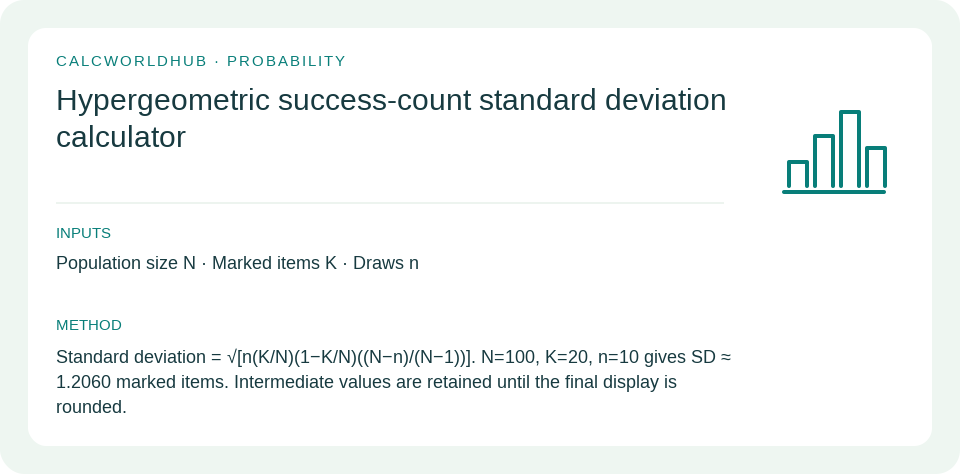
Standard deviation = √[n(K/N)(1−K/N)((N−n)/(N−1))].
N=100, K=20, n=10 gives SD ≈ 1.2060 marked items.
Intermediate values are retained until the final display is rounded.
What the probability or expectation means
This is a model average, not a promise about the next run. Individual counts can fall on either side of an expectation.
Assumptions and limits
Requires integer counts and N > 1; this summarizes spread rather than the probability of a particular count.
Frequently asked questions
What does this standard deviation measure?
It measures the spread in the number of marked items drawn without replacement, in count units. It is not the probability of a particular count.
Why is there a finite-population correction?
Without replacement, each draw changes the remaining composition. The factor (N−n)/(N−1) reduces the variance relative to independent binomial draws.
What input combinations are valid?
N, K, and n are integer counts with N>1, 0≤K≤N, and 0≤n≤N; all refer to the same population and sample.
How do I use the Hypergeometric success-count standard deviation calculator?
Enter Population size N, Marked items K, Draws n. Match the units shown beside each field and review the result together with the assumptions below.
What is a worked example of Hypergeometric success-count standard deviation?
Standard deviation = √[n(K/N)(1−K/N)((N−n)/(N−1))]. N=100, K=20, n=10 gives SD ≈ 1.2060 marked items. Intermediate values are retained until the final display is rounded.
Read the calculation methodology and privacy policy.