How to use this calculator
Convert a local input voltage slope into the output of an ideal inverting differentiator.
- Enter Feedback resistance (kΩ), Input capacitance (nF), Input voltage slope (V/ms). Match the units shown beside each field and review the result together with the assumptions below.
- Read the worked example below to check the expected input format and result.
- Compare another scenario by changing one input at a time. Use Reset to return to the starting values.
Ideal op amp differentiator explained
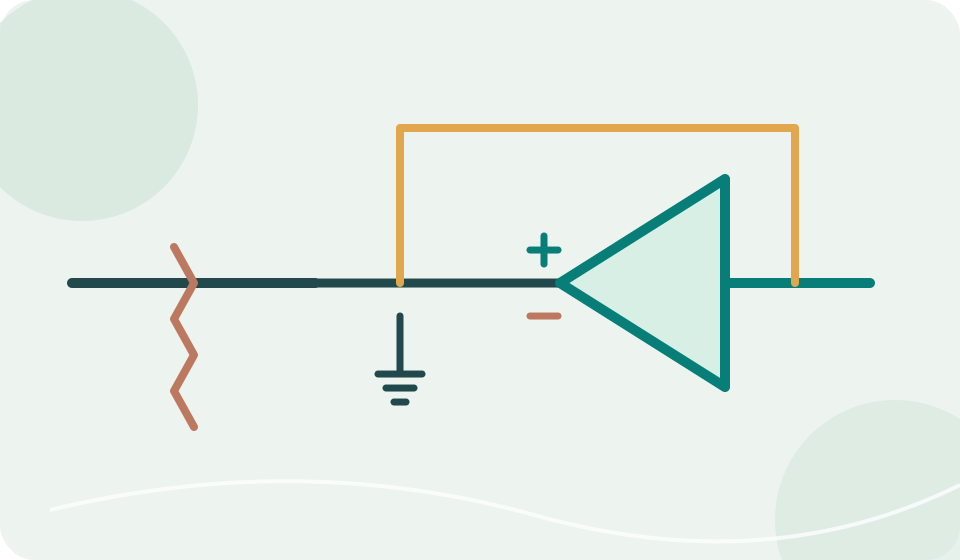
An ideal inverting differentiator produces an output proportional to the instantaneous input-voltage slope: a faster rise makes a more negative output. The calculator converts the entered kΩ, nF, and V/ms units consistently; a real circuit’s bandwidth and noise behavior require additional component modeling.
Inputs, symbols, and units
r— Feedback resistance (kΩ)- Feedback resistance (kΩ).
c— Input capacitance (nF)- Input capacitance (nF).
s— Input voltage slope (V/ms)- Input voltage slope (V/ms).
Formula and method
Vout=−RC(dVin/dt), using seconds.
Symbols use the input definitions below. A constant local slope is assumed.
A worked scenario
Feedback resistance (kΩ) = 22; Input capacitance (nF) = 10; Input voltage slope (V/ms) = 0.5.
- Ideal op amp differentiator: -0.11 V
This scenario uses the stated units and assumptions. Displayed values are rounded only after calculation.
Assumptions and edge cases
A constant local slope is assumed. Practical differentiators require bandwidth limiting and noise control.
Frequently asked questions
Does slope sign matter?
Yes, the output reverses it.
Is input voltage itself sufficient?
No, the derivative depends on its rate of change.
Does this predict high-frequency noise?
No, component and amplifier bandwidth are idealized.
How do I use the Ideal op amp differentiator calculator?
Enter Feedback resistance (kΩ), Input capacitance (nF), Input voltage slope (V/ms). Match the units shown beside each field and review the result together with the assumptions below.
What is a worked example of Ideal op amp differentiator?
Feedback resistance (kΩ) = 22; Input capacitance (nF) = 10; Input voltage slope (V/ms) = 0.5. Ideal op amp differentiator: -0.11 V This scenario uses the stated units and assumptions. Displayed values are rounded only after calculation.
Read our calculation methodology.