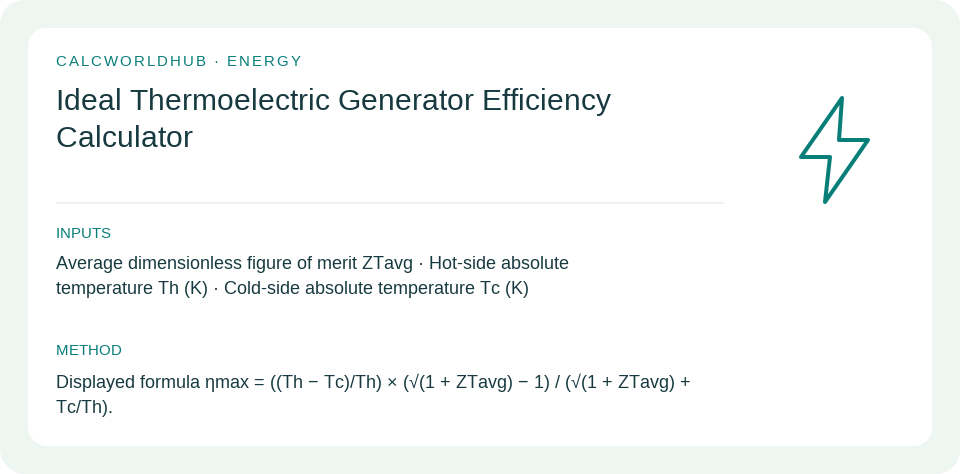
How to use this calculator
Estimate the ideal maximum conversion efficiency from average ZT and hot- and cold-side temperatures.
- Enter Average dimensionless figure of merit ZTavg, Hot-side absolute temperature Th (K), Cold-side absolute temperature Tc (K). Match the units shown beside each field and review the result together with the assumptions below.
- Read the worked example below to check the expected input format and result.
- Compare another scenario by changing one input at a time. Use Reset to return to the starting values.
How this calculation works
The ideal thermoelectric generator limit combines Carnot efficiency with a material figure-of-merit factor. The equation assumes a uniform, temperature-independent figure of merit over the span and matched operation under the ideal model.
Inputs and units
ztAverage— Average dimensionless figure of merit ZTavg- Average thermoelectric figure of merit over the operating temperature range.
hotTemperature— Hot-side absolute temperature Th (K)- Absolute temperature at the hot side.
coldTemperature— Cold-side absolute temperature Tc (K)- Absolute temperature at the cold side.
Formula
ηmax = ((Th − Tc)/Th) × (√(1 + ZTavg) − 1) / (√(1 + ZTavg) + Tc/Th).
Method
Calculate the Carnot limit from the absolute hot and cold temperatures, then multiply by the efficiency fraction set by the entered average dimensionless figure of merit.
Worked example
For ZTavg = 1.00, Th = 500 K, and Tc = 300 K, the ideal maximum efficiency is 8.226%, compared with a 40.00% Carnot limit.
Assumptions and limits
Use absolute temperatures in kelvin and an average ZT appropriate to the temperature span. This is an ideal material-level estimate, not a device prediction; contacts, heat leakage, geometry, property variation, and load conditions can lower real efficiency.
Frequently asked questions
What does average ZT mean?
It is the dimensionless material figure of merit averaged over the thermoelectric material operating temperature range.
Is this the efficiency of a commercial module?
No. It is an idealized material-level limit. Real modules lose efficiency through contacts, heat leakage, nonuniform temperatures, and property changes.
Why use kelvin?
The thermodynamic efficiency equation uses absolute hot- and cold-side temperatures. Celsius values must be converted to kelvin.
How do I use the Ideal Thermoelectric Generator Efficiency Calculator?
Enter Average dimensionless figure of merit ZTavg, Hot-side absolute temperature Th (K), Cold-side absolute temperature Tc (K). Match the units shown beside each field and review the result together with the assumptions below.
What is a worked example of Ideal Thermoelectric Generator Efficiency?
For ZTavg = 1.00, Th = 500 K, and Tc = 300 K, the ideal maximum efficiency is 8.226%, compared with a 40.00% Carnot limit.
Reference: Peer-reviewed thermoelectric figure-of-merit and ideal efficiency model. See our calculation methodology.