How to use this calculator
Calculate the dimensionless thermoelectric figure of merit from Seebeck coefficient, electrical conductivity, temperature, and thermal conductivity.
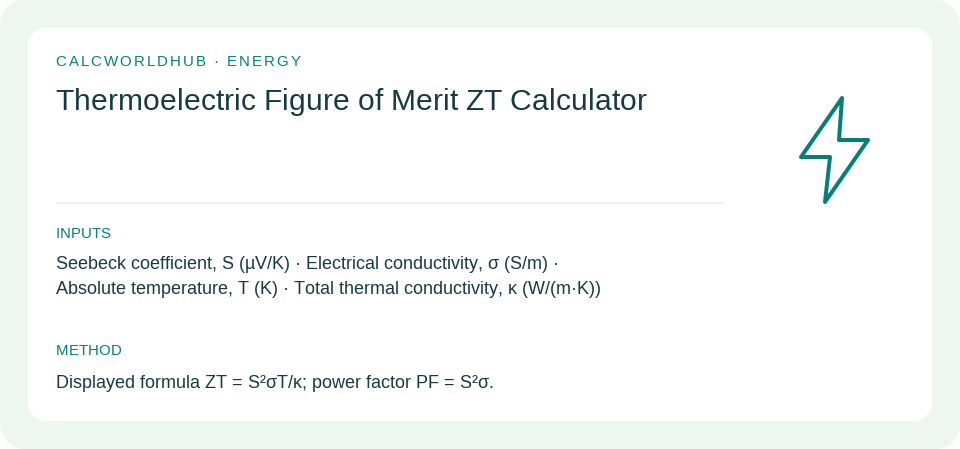
- Enter Seebeck coefficient, S (µV/K), Electrical conductivity, σ (S/m), Absolute temperature, T (K), Total thermal conductivity, κ (W/(m·K)). Match the units shown beside each field and review the result together with the assumptions below.
- Read the worked example below to check the expected input format and result.
- Compare another scenario by changing one input at a time. Use Reset to return to the starting values.
How this calculation works
The thermoelectric figure of merit compares electrical power generation capability with heat conduction at an operating temperature. It combines the Seebeck coefficient, electrical conductivity, and total thermal conductivity into a dimensionless material-performance parameter.
Inputs and units
seebeckUvK— Seebeck coefficient, S (µV/K)- Magnitude of the material Seebeck coefficient.
electricalConductivity— Electrical conductivity, σ (S/m)- Electrical conductivity at the specified operating temperature.
temperatureK— Absolute temperature, T (K)- Temperature at which the material properties are evaluated.
thermalConductivity— Total thermal conductivity, κ (W/(m·K))- Total thermal conductivity at the same temperature.
Formula
ZT = S²σT/κ; power factor PF = S²σ.
Method
Enter Seebeck coefficient in µV/K, electrical conductivity in S/m, absolute temperature in K, and total thermal conductivity in W/(m·K). Conductivity and power factor are calculated from properties at the same temperature.
Worked example
For S = 200 µV/K, σ = 100,000 S/m, T = 300 K, and κ = 1.5 W/(m·K), the power factor is 4 mW/(m·K²) and ZT = 0.80.
Assumptions and limits
ZT is a material property evaluated at a specified temperature and does not by itself predict device efficiency across a temperature gradient. Temperature dependence, contact resistance, geometry, heat leakage, and coupled transport require a device-level model.
Frequently asked questions
What is ZT?
It is a dimensionless material figure of merit formed from Seebeck coefficient, electrical conductivity, thermal conductivity, and absolute temperature.
Should thermal conductivity include both contributions?
Use the total thermal conductivity measured or modeled for the material at the stated temperature.
Does a material ZT give a device efficiency?
No. A thermoelectric device efficiency also depends on temperature span, property variation, geometry, contacts, and heat losses.
How do I use the Thermoelectric Figure of Merit ZT Calculator?
Enter Seebeck coefficient, S (µV/K), Electrical conductivity, σ (S/m), Absolute temperature, T (K), Total thermal conductivity, κ (W/(m·K)). Match the units shown beside each field and review the result together with the assumptions below.
What is a worked example of Thermoelectric Figure of Merit ZT?
For S = 200 µV/K, σ = 100,000 S/m, T = 300 K, and κ = 1.5 W/(m·K), the power factor is 4 mW/(m·K²) and ZT = 0.80.
Reference: Peer-reviewed thermoelectric material figure-of-merit definition and analysis. See our calculation methodology.