How to use this calculator
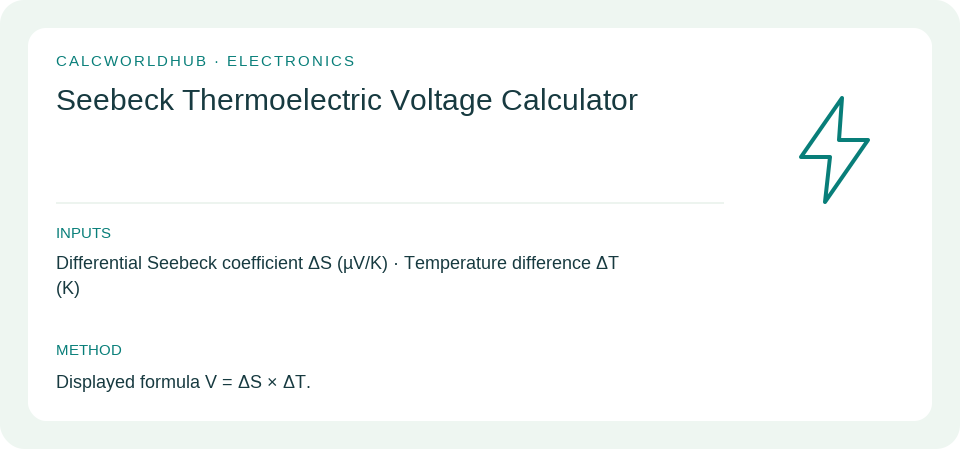
Estimate open-circuit thermoelectric voltage from a differential Seebeck coefficient and temperature difference.
- Enter Differential Seebeck coefficient ΔS (µV/K), Temperature difference ΔT (K). Match the units shown beside each field and review the result together with the assumptions below.
- Read the worked example below to check the expected input format and result.
- Compare another scenario by changing one input at a time. Use Reset to return to the starting values.
How this calculation works
The Seebeck coefficient relates an applied temperature difference to thermoelectric voltage. For a constant differential coefficient across the measured interval, voltage is the coefficient multiplied by the hot-to-cold temperature difference.
Inputs and units
deltaSMicroVPerK— Differential Seebeck coefficient ΔS (µV/K)- Difference in thermopower between the two materials or legs, with a consistent polarity convention.
deltaTK— Temperature difference ΔT (K)- Magnitude of the hot-to-cold temperature difference in kelvins.
Formula
V = ΔS × ΔT.
Method
Enter the differential Seebeck coefficient in microvolts per kelvin and the nonnegative temperature difference in kelvins. The result is converted to millivolts; a signed coefficient indicates voltage polarity under the chosen convention.
Worked example
A differential Seebeck coefficient of 200 µV/K across 50 K produces an ideal open-circuit voltage of 10.000 mV.
Assumptions and limits
The tool assumes a constant differential coefficient across the entered temperature interval and reports an ideal open-circuit voltage. It does not account for contact effects, material gradients, internal resistance, load current, or temperature-dependent coefficients.
Frequently asked questions
Why use a differential coefficient?
A thermoelectric circuit contains materials or legs with a voltage difference between their Seebeck responses.
Can the coefficient be negative?
Yes. Its sign depends on the voltage polarity convention and material pairing.
Is this the loaded output voltage?
No. It estimates open-circuit thermoelectric voltage and does not subtract voltage drop under load.
How do I use the Seebeck Thermoelectric Voltage Calculator?
Enter Differential Seebeck coefficient ΔS (µV/K), Temperature difference ΔT (K). Match the units shown beside each field and review the result together with the assumptions below.
What is a worked example of Seebeck Thermoelectric Voltage?
A differential Seebeck coefficient of 200 µV/K across 50 K produces an ideal open-circuit voltage of 10.000 mV.
Reference: NIST Seebeck coefficient and thermoelectric voltage reference. See our calculation methodology.