How to use this calculator
Evaluate a shallow translational slope mechanism with a parallel slip plane and an explicit saturated-thickness assumption.
- Enter Slope angle (degrees), Vertical soil thickness (m), Total unit weight (kN/m³), Effective cohesion (kPa), then complete the remaining labeled fields. Match the units shown beside each field and review the result together with the assumptions below.
- Read the worked example below to check the expected input format and result.
- Compare another scenario by changing one input at a time. Use Reset to return to the starting values.
Infinite slope stability with parallel seepage explained
This infinite-slope model compares resisting shear strength with downslope driving stress on a plane parallel to the surface. It uses vertical soil depth and a saturated fraction to reduce effective normal stress for parallel seepage. The factor of safety is a limit-equilibrium screening value; layering, transient pore pressure, surcharge, seismic loading, and three-dimensional effects are not represented.
Inputs, symbols, and units
beta— Slope angle (degrees)- Ground and potential planar slip surface angle from horizontal.
z— Vertical soil thickness (m)- Vertical depth to a plane parallel to the ground surface.
g— Total unit weight (kN/m³)- Uniform total weight of the sliding soil.
c— Effective cohesion (kPa)- Effective cohesion intercept mobilized along the plane.
phi— Effective friction angle (degrees)- Drained friction angle on the plane.
m— Saturated thickness fraction- Fraction of the vertical thickness represented by parallel seepage pore pressure.
Formula and method
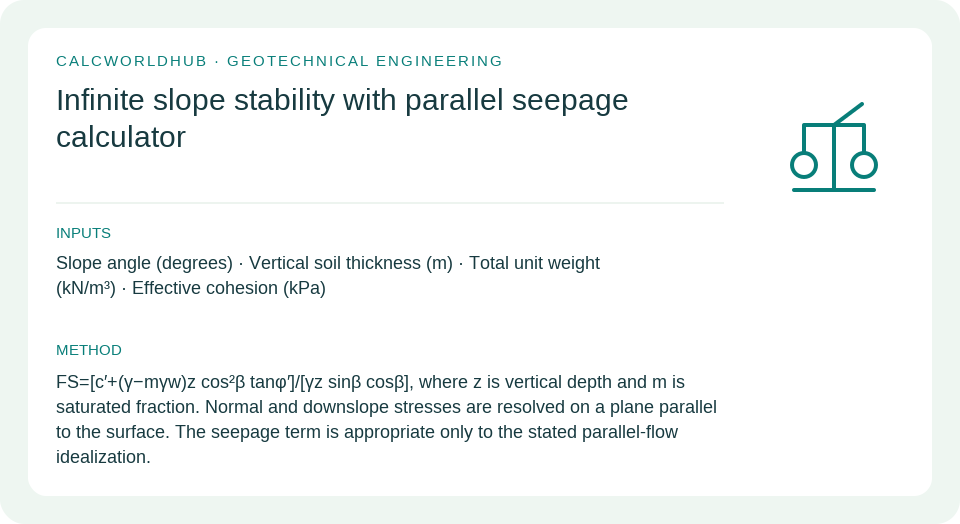
FS=[c′+(γ−mγw)z cos²β tanφ′]/[γz sinβ cosβ], where z is vertical depth and m is saturated fraction.
Normal and downslope stresses are resolved on a plane parallel to the surface. The seepage term is appropriate only to the stated parallel-flow idealization.
A worked scenario
Slope angle (degrees) = 25; Vertical soil thickness (m) = 2; Total unit weight (kN/m³) = 20; Effective cohesion (kPa) = 3; Effective friction angle (degrees) = 32; Saturated thickness fraction = 0.5.
- Factor of safety: 1.207316
- Driving shear stress: 15.320889 kPa
- Pore pressure on plane: 8.055122 kPa
A 25° slope has 2 m vertical soil thickness, γ=20 kN/m³, c′=3 kPa, φ′=32° and half the thickness saturated under parallel seepage.
Assumptions and edge cases
Long uniform slope, shallow plane, drained strength and no toe/end effects, seismic inertia or reinforcing loads. Educational model; this is not a code-compliant design check.
Reading the outputs
FS is resisting shear divided by driving shear; driving stress and modeled pore pressure are shown in kPa.
Frequently asked questions
Is z measured perpendicular to the slope?
No. This formula and input use vertical thickness; using normal thickness without conversion changes both stresses.
Can m model a perched pressure above hydrostatic?
No. Entering m is only a parallel seepage fraction, not a general pore-pressure boundary condition.
What does FS=1 mean?
It is limiting equilibrium for this ideal plane, without a design margin or reliability statement.
How do I use the Infinite slope stability with parallel seepage calculator?
Enter Slope angle (degrees), Vertical soil thickness (m), Total unit weight (kN/m³), Effective cohesion (kPa), then complete the remaining labeled fields. Match the units shown beside each field and review the result together with the assumptions below.
What is a worked example of Infinite slope stability with parallel seepage?
Slope angle (degrees) = 25; Vertical soil thickness (m) = 2; Total unit weight (kN/m³) = 20; Effective cohesion (kPa) = 3; Effective friction angle (degrees) = 32; Saturated thickness fraction = 0.5. Factor of safety: 1.207316 Driving shear stress: 15.320889 kPa Pore pressure on plane: 8.055122 kPa A 25° slope has 2 m vertical soil thickness, γ=20 kN/m³, c′=3 kPa, φ′=32° and half the thickness saturated under parallel seepage.
Background or definition reference: USACE EM 1110-2-1902, Slope Stability.
Reference access note: The linked USACE slope-stability manual was not retrievable during this review. The stated equation and numerical example were checked independently; verify against the manual before design use.
Read our calculation methodology.