How to use this calculator
Calculate the share of average headcount with a promotion during a defined reporting period.
- Enter Distinct employees promoted, Average headcount. Match the units shown beside each field and review the result together with the assumptions below.
- Read the worked example below to check the expected input format and result.
- Compare another scenario by changing one input at a time. Use Reset to return to the starting values.
How this calculation works
An internal promotion rate expresses distinct employees promoted during a period relative to the organization’s average headcount over that period. Count each promoted employee once, even if more than one role change was recorded, and use a consistent definition of promotion and workforce scope.
Inputs and units
employeesPromoted— Distinct employees promoted- Count unique employees receiving a qualifying promotion during the period.
averageHeadcount— Average headcount- Use the average employee headcount for the same population and period.
Formula
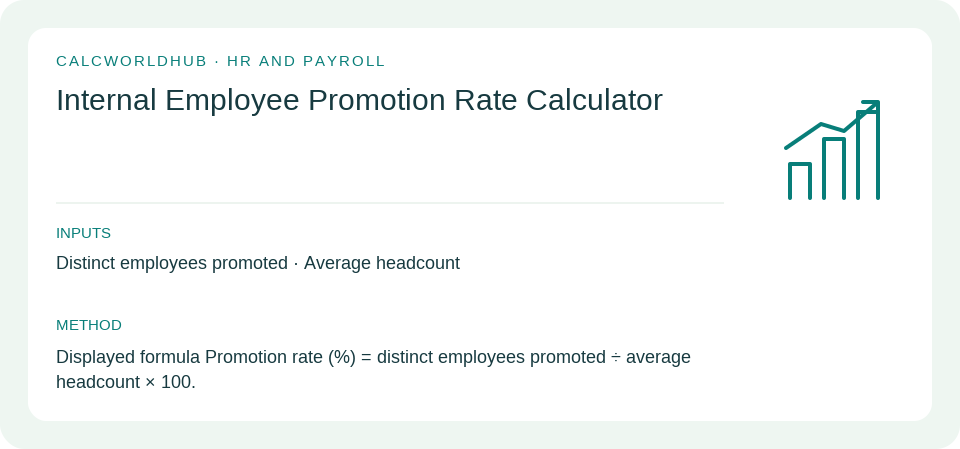
Promotion rate (%) = distinct employees promoted ÷ average headcount × 100.
Method
Count distinct employees receiving a qualifying promotion in the period, then divide by average headcount for the same workforce scope and dates. A team may also report promotions per 100 employees for easier comparison.
Worked example
If 18 distinct employees are promoted in a workforce with average headcount 600, the internal promotion rate is 3.00%.
Assumptions and limits
Organizations define promotions differently, including changes in grade, level, or formal job family. This rate is not the share of vacancies filled internally. If workforce membership changes, the distinct promoted-employee count can exceed average headcount, so the calculated rate can exceed 100%.
Frequently asked questions
Is this an internal fill rate?
No. It measures promoted employees relative to average headcount, not internal hires divided by vacancies filled.
Should repeat promotions count twice?
This calculator counts distinct employees once during the period. Use the same rule for every comparison.
How should average headcount be measured?
Use a consistent average of workforce snapshots over the reporting period and match the population to the promotion count.
Can the rate exceed 100%?
Yes. If the employee population changes during a long reporting period, distinct promoted employees can exceed average headcount; interpret the result with its cohort and period.
How do I use the Internal Employee Promotion Rate Calculator?
Enter Distinct employees promoted, Average headcount. Match the units shown beside each field and review the result together with the assumptions below.
Read our calculation methodology.