How to use this calculator
Propagate bounded independent scalar inputs through multiplication and division using endpoint enclosures.
- Enter First interval lower endpoint, First interval upper endpoint, Second interval lower endpoint, Second interval upper endpoint. Match the units shown beside each field and review the result together with the assumptions below.
- Read the worked example below to check the expected input format and result.
- Compare another scenario by changing one input at a time. Use Reset to return to the starting values.
Interval product and quotient enclosure explained
Interval multiplication checks all four endpoint products to find the outer bounds. Division uses endpoint quotients only when the denominator interval excludes zero; the results are deterministic bounds, not probabilities.
Inputs, symbols, and units
a— First interval lower endpoint- Inclusive lower endpoint of interval A.
b— First interval upper endpoint- Inclusive upper endpoint of interval A.
c— Second interval lower endpoint- Inclusive lower endpoint of interval B.
d— Second interval upper endpoint- Inclusive upper endpoint of interval B.
Formula and method
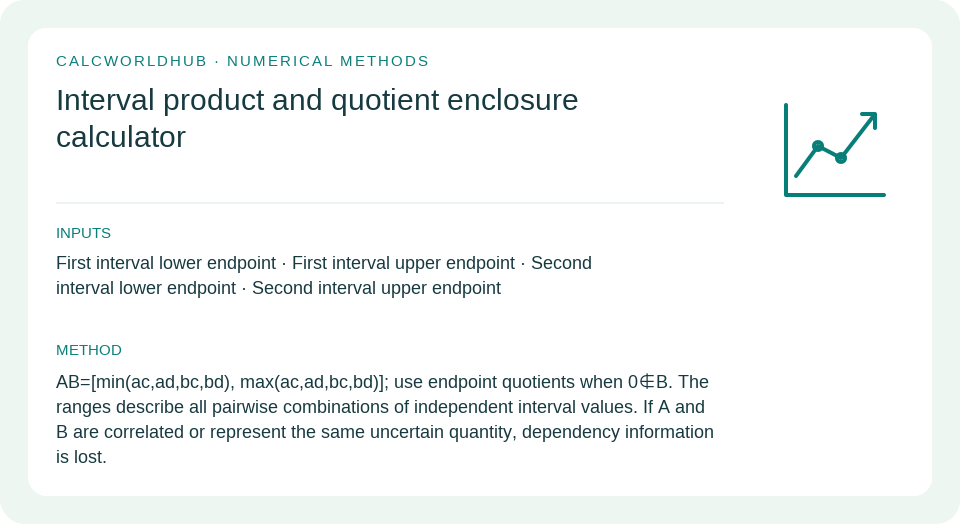
AB=[min(ac,ad,bc,bd), max(ac,ad,bc,bd)]; use endpoint quotients when 0∉B.
The ranges describe all pairwise combinations of independent interval values. If A and B are correlated or represent the same uncertain quantity, dependency information is lost.
A worked scenario
First interval lower endpoint = -2; First interval upper endpoint = 3; Second interval lower endpoint = 1; Second interval upper endpoint = 4.
- Product lower bound: -8 A × B units
- Product upper bound: 12 A × B units
- Quotient lower bound: -2 A / B units
- Quotient upper bound: 3 A / B units
Intervals [−2,3] and [1,4] multiply into [−8,12] and divide into [−2,3].
Assumptions and edge cases
Mathematical endpoint formulas use ordinary binary64 rounding, not directed outward rounding; these are practical numeric enclosures, not machine-certified interval arithmetic.
Reading the outputs
Two product bounds and two quotient bounds carry their respective combined units.
Frequently asked questions
Why reject a denominator interval crossing zero?
The quotient becomes unbounded or disconnected and cannot be represented by one finite interval.
Can one endpoint equal the other?
Yes. That represents an exact scalar value.
Are these probability intervals?
No. They are deterministic ranges, with no probability attached.
How do I use the Interval product and quotient enclosure calculator?
Enter First interval lower endpoint, First interval upper endpoint, Second interval lower endpoint, Second interval upper endpoint. Match the units shown beside each field and review the result together with the assumptions below.
What is a worked example of Interval product and quotient enclosure?
First interval lower endpoint = -2; First interval upper endpoint = 3; Second interval lower endpoint = 1; Second interval upper endpoint = 4. Product lower bound: -8 A × B units Product upper bound: 12 A × B units Quotient lower bound: -2 A / B units Quotient upper bound: 3 A / B units Intervals [−2,3] and [1,4] multiply into [−8,12] and divide into [−2,3].
Read our calculation methodology.