How to use this calculator
Assess an already computed linear-system solution using a scale-normalized residual rather than solving the equations again.
- Enter Matrix entries, row-major, Right-hand side, Computed solution. Match the units shown beside each field and review the result together with the assumptions below.
- Read the worked example below to check the expected input format and result.
- Compare another scenario by changing one input at a time. Use Reset to return to the starting values.
Linear system normwise backward error explained
Measure how closely an approximate solution satisfies a linear system relative to the matrix, solution, and right-hand-side scales. A small backward error describes a nearby solved system, not necessarily small forward solution error.
Inputs, symbols, and units
a— Matrix entries, row-major- Square matrix, entered row by row; 2–10 rows are supported. Use comma-separated values in the stated order.
b— Right-hand side- One equation right-hand side per matrix row. Use comma-separated values in the stated order.
x— Computed solution- Approximate solution to assess, in unknown order. Use comma-separated values in the stated order.
Formula and method
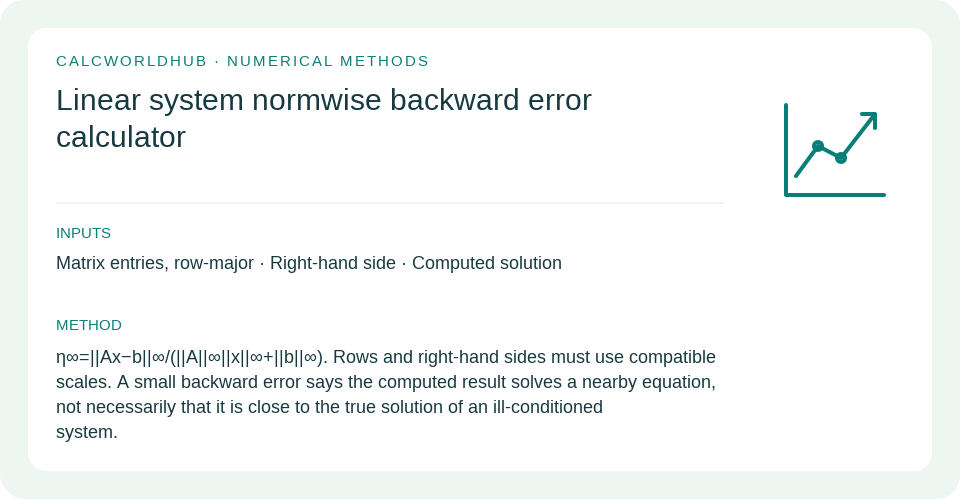
η∞=||Ax−b||∞/(||A||∞||x||∞+||b||∞).
Rows and right-hand sides must use compatible scales. A small backward error says the computed result solves a nearby equation, not necessarily that it is close to the true solution of an ill-conditioned system.
A worked scenario
Matrix entries, row-major = [4, 1, 0, 1, 3, 1, 0, 1, 2]; Right-hand side = [1, 2, 3]; Computed solution = [0.22, 0.12, 1.44].
- Normwise backward error: 0.001961
- Infinity residual norm: 0.02 equation units
- Matrix infinity norm: 5
For the displayed three-equation system, the candidate (0.22,0.12,1.44) leaves a maximum equation residual of 0.02.
Assumptions and edge cases
Mixed-unit equations should be nondimensionalized. This page does not estimate condition number or convert a backward error into a forward-error bound.
Reading the outputs
Backward error is dimensionless. Residual is in right-hand-side units; the infinity matrix norm is the maximum absolute row sum.
Frequently asked questions
Why can a tiny residual accompany a wrong answer?
An ill-conditioned matrix can turn small equation changes into large solution changes.
Can equations be rescaled?
Yes, but the chosen normwise measure changes with row scaling.
Do I enter the exact solution?
Enter the approximate solution you want to assess.
How do I use the Linear system normwise backward error calculator?
Enter Matrix entries, row-major, Right-hand side, Computed solution. Match the units shown beside each field and review the result together with the assumptions below.
What is a worked example of Linear system normwise backward error?
Matrix entries, row-major = [4, 1, 0, 1, 3, 1, 0, 1, 2]; Right-hand side = [1, 2, 3]; Computed solution = [0.22, 0.12, 1.44]. Normwise backward error: 0.001961 Infinity residual norm: 0.02 equation units Matrix infinity norm: 5 For the displayed three-equation system, the candidate (0.22,0.12,1.44) leaves a maximum equation residual of 0.02.
Background or definition reference: NIST DLMF numerical methods.
Read our calculation methodology.