How to use this calculator
Find the time and speed for purely radial fall from rest in an inverse-square central gravitational field.
- Enter Release radius from center (km), Final inward radius (km), Central gravitational parameter (km^3/s^2). Match the units shown beside each field and review the result together with the assumptions below.
- Read the worked example below to check the expected input format and result.
- Compare another scenario by changing one input at a time. Use Reset to return to the starting values.
Inverse square radial fall time from rest explained
How the calculation works
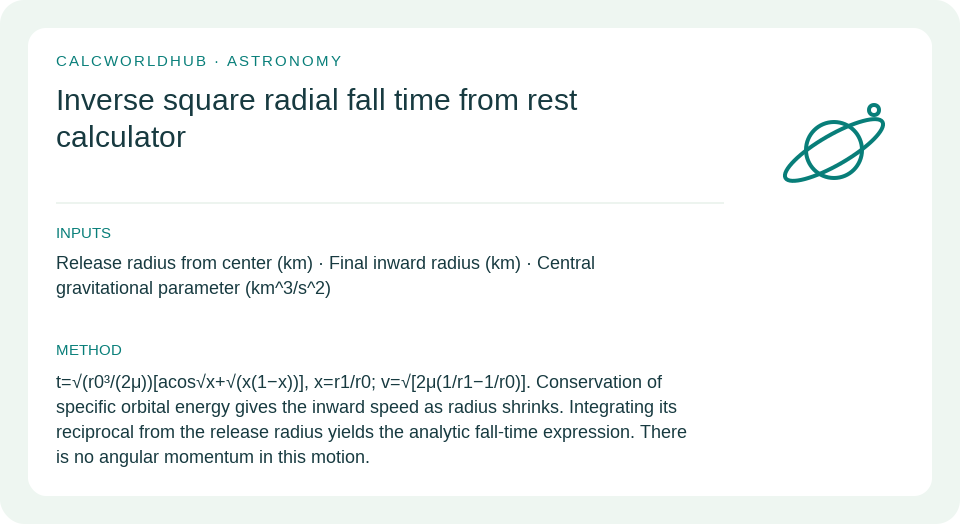
t=√(r0³/(2μ))[acos√x+√(x(1−x))], x=r1/r0; v=√[2μ(1/r1−1/r0)].
Conservation of specific orbital energy gives the inward speed as radius shrinks. Integrating its reciprocal from the release radius yields the analytic fall-time expression. There is no angular momentum in this motion.
Set up the calculation
r0— Release radius from center (km)- Length measured in kilometres.
r1— Final inward radius (km)- Length measured in kilometres.
mu— Central gravitational parameter (km^3/s^2)- Positive central-body parameter G times mass, in km³/s².
Limits of this model
Point-mass gravity, release from rest, zero transverse velocity, and positive final radius no larger than release radius. The model does not stop at a physical surface or include drag, rotation, or relativistic effects.
Check this example
Release radius from center (km) = 20000; Final inward radius (km) = 7000; Central gravitational parameter (km^3/s^2) = 398600.4418.
- Radial fall time from rest: 4481.56590133 s
- Inward final speed: 8.603824518 km/s
- Specific potential energy released: 37.012898167 km^2/s^2
Falling from twenty thousand to seven thousand kilometres samples a strongly changing gravitational acceleration, unlike a short near-surface drop with constant g.
Reading the outputs
The displayed speed is a positive inward magnitude. Energy released is specific energy in km²/s², not the total energy of a supplied mass.
Frequently asked questions
Can I use ordinary free-fall height?
That approximation uses nearly constant g; here both radii are measured from the center.
Is this an ordinary orbit?
It is a degenerate zero-angular-momentum radial trajectory, not a nonradial ellipse.
Does the tool check impact with Earth?
No. The endpoint is supplied by the user.
How do I use the Inverse square radial fall time from rest calculator?
Enter Release radius from center (km), Final inward radius (km), Central gravitational parameter (km^3/s^2). Match the units shown beside each field and review the result together with the assumptions below.
What is a worked example of Inverse square radial fall time from rest?
Release radius from center (km) = 20000; Final inward radius (km) = 7000; Central gravitational parameter (km^3/s^2) = 398600.4418. Radial fall time from rest: 4481.56590133 s Inward final speed: 8.603824518 km/s Specific potential energy released: 37.012898167 km^2/s^2 Falling from twenty thousand to seven thousand kilometres samples a strongly changing gravitational acceleration, unlike a short near-surface drop with constant g.
Read our calculation methodology.