Inverse-square sound intensity calculator
Scale the known intensity by the inverse square of the distance ratio.
Calculator
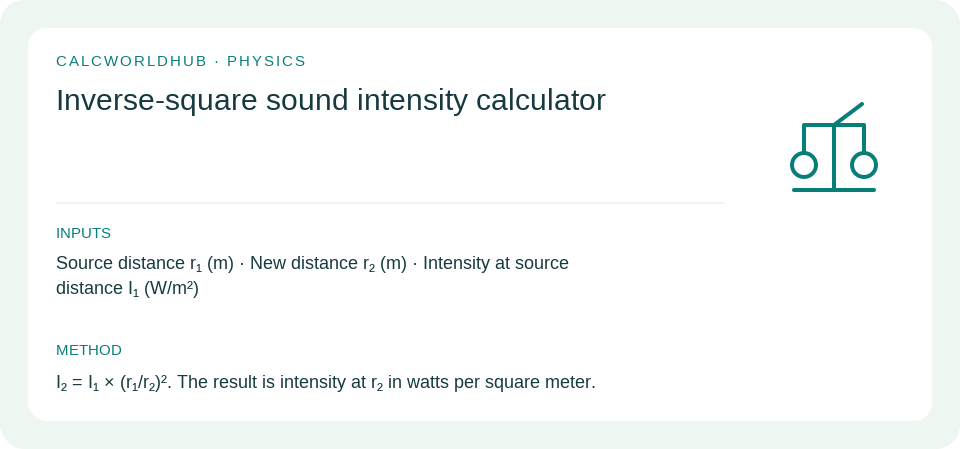
How to use this calculator
Estimate free-field sound intensity at a second distance using I₂=I₁(r₁/r₂)².
- Enter Source distance r₁ (m), New distance r₂ (m), Intensity at source distance I₁ (W/m²). Match the units shown beside each field and review the result together with the assumptions below.
- Read the worked example below to check the expected input format and result.
- Compare another scenario by changing one input at a time. Use Reset to return to the starting values.
Estimate sound intensity at a second distance
For an ideal point source spreading sound uniformly in a free field, intensity decreases with the square of distance. Enter intensity at the first distance and the two distances.
Inputs and units
- Source distance r₁ (m): Positive distance where the known intensity applies.
- New distance r₂ (m): Positive distance where intensity is estimated.
- Intensity at source distance I₁ (W/m²): Nonnegative sound intensity measured or assumed at r₁.
Formula and method
I₂ = I₁ × (r₁/r₂)². The result is intensity at r₂ in watts per square meter.
Worked example
At I₁ = 1×10⁻⁵ W/m² and r₁ = 2 m, the intensity at r₂ = 4 m is 1×10⁻⁵×(2/4)² = 2.5×10⁻⁶ W/m².
Interpreting the result
Doubling distance gives one quarter the intensity in this model. The result is displayed in scientific notation so small intensities remain visible.
Assumptions and limits
Assumes free-field spherical spreading from a point source. It excludes absorption, reflections, barriers, source directivity, and room acoustics. Pressure, reference pressure, and frequency do not change this intensity-only formula.
Method references
Frequently asked questions
Why are pressure and frequency not inputs?
They are not used by the stated distance-spreading formula; pressure level needs additional acoustic assumptions.
Does this predict sound level in a room?
Not reliably. Reflections and absorption can change the field substantially.
How do I use the Inverse-square sound intensity calculator?
Enter Source distance r₁ (m), New distance r₂ (m), Intensity at source distance I₁ (W/m²). Match the units shown beside each field and review the result together with the assumptions below.
What is a worked example of Inverse-square sound intensity?
At I₁ = 1×10⁻⁵ W/m² and r₁ = 2 m, the intensity at r₂ = 4 m is 1×10⁻⁵×(2/4)² = 2.5×10⁻⁶ W/m².
What does the Inverse-square sound intensity calculator calculate?
Estimate free-field sound intensity at a second distance using I₂=I₁(r₁/r₂)².
Good calculators show their work.
CalcWorldHub is built around clear inputs and visible assumptions. Results are estimates for planning; check official sources or your provider’s terms when exact figures matter.