Sound intensity level calculator
Convert acoustic intensity into a decibel level relative to the standard air-intensity reference.
Calculator
How to use this calculator
Convert acoustic intensity into a decibel level relative to the standard air-intensity reference.
- Enter Sound intensity at r₁ (W/m²). Match the units shown beside each field and review the result together with the assumptions below.
- Read the worked example below to check the expected input format and result.
- Compare another scenario by changing one input at a time. Use Reset to return to the starting values.
Sound intensity level calculator
Convert acoustic intensity into a decibel level relative to the standard air-intensity reference.
Inputs and units
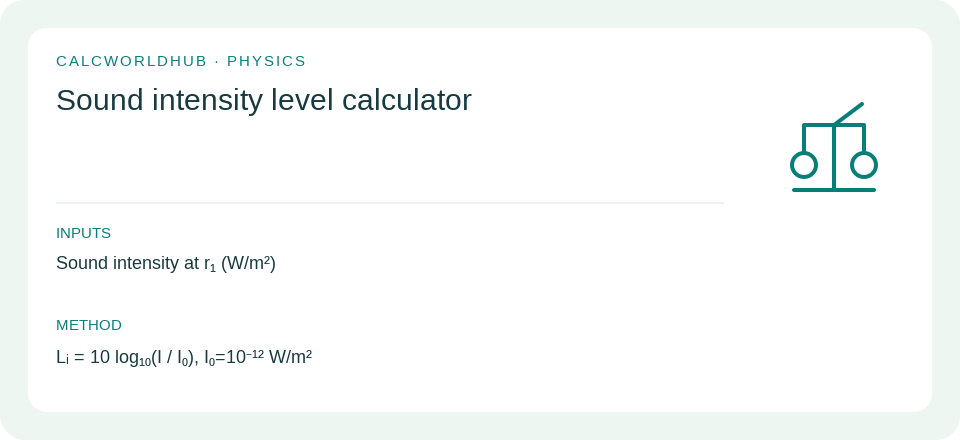
- Sound intensity at r₁ (W/m²): Acoustic power per area in W/m²; it must be positive because the logarithm is undefined at zero.
Formula and method
Lᵢ = 10 log₁₀(I / I₀), I₀=10⁻¹² W/m²
Worked example
At I=10⁻⁵ W/m², Lᵢ=10 log₁₀(10⁷)=70 dB.
Interpreting the result
Each tenfold intensity increase adds 10 dB. This is an intensity level, not a direct loudness or hearing-risk assessment.
Assumptions and limits
Intensity must be positive and measured in W/m²; the conventional reference is 10⁻¹² W/m². Environmental weighting and exposure duration are outside this conversion.
Sources and method
- Defines the intensity level using 10 log10(I/I0) and the conventional 10^-12 W/m² reference; pressure level uses the logarithmic pressure ratio. OpenStax University Physics Volume 1: sound intensity
Frequently asked questions
Which inputs determine this result?
The visible inputs are Sound intensity at r₁ (W/m²). Each is used by the displayed formula; the calculator does not use any other hidden measurement.
When does this method apply?
Intensity must be positive and measured in W/m²; the conventional reference is 10⁻¹² W/m². Environmental weighting and exposure duration are outside this conversion.
How do I use the Sound intensity level calculator?
Enter Sound intensity at r₁ (W/m²). Match the units shown beside each field and review the result together with the assumptions below.
What is a worked example of Sound intensity level?
At I=10⁻⁵ W/m², Lᵢ=10 log₁₀(10⁷)=70 dB.
What does the Sound intensity level calculator calculate?
Convert acoustic intensity into a decibel level relative to the standard air-intensity reference.
See the calculation methodology.
Good calculators show their work.
CalcWorldHub is built around clear inputs and visible assumptions. Results are estimates for planning; check official sources or your provider’s terms when exact figures matter.