How to use this calculator
Compare current holdings with target weights to estimate how much to buy or sell in each asset.
- Enter Current market values (comma-separated), Target weights (comma-separated %). Match the units shown beside each field and review the result together with the assumptions below.
- Read the worked example below to check the expected input format and result.
- Compare another scenario by changing one input at a time. Use Reset to return to the starting values.
How this calculation works
Rebalancing translates a target allocation into trades. The calculator first totals the entered holdings, then applies each target percentage to that same total; the difference from each current value is the estimated trade amount.
Inputs and units
values— Current market values (comma-separated)- Enter one nonnegative value per holding, in a consistent currency. Keep the order aligned with the target-weight list.
weights— Target weights (comma-separated %)- Enter target percentages in the same order; the values must total 100%.
Formula
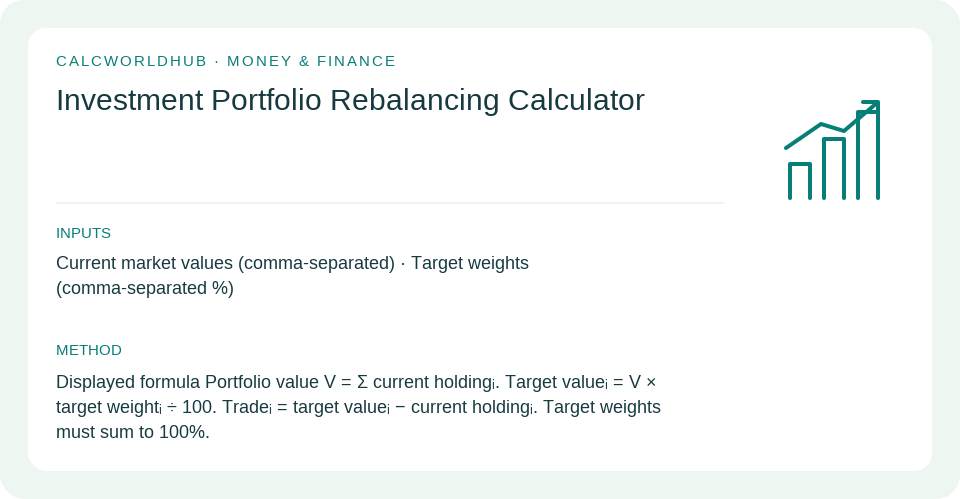
Portfolio value V = Σ current holdingᵢ. Target valueᵢ = V × target weightᵢ ÷ 100. Tradeᵢ = target valueᵢ − current holdingᵢ. Target weights must sum to 100%.
Method
Enter current market values and target weights as comma-separated lists in the same asset order. Use at least two assets, provide the same number of values in each list, and make the target percentages add to 100%. Positive trade means buy; negative trade means sell.
Worked example
A portfolio worth 100,000 with current values 45,000 / 35,000 / 20,000 and targets 50% / 30% / 20% has target values 50,000 / 30,000 / 20,000. Buy 5,000 of asset 1 and sell 5,000 of asset 2.
Assumptions and limits
The estimate assumes trades can be made at entered market values and ignores taxes, transaction fees, bid–ask spreads, minimum trade sizes, cash flows, and price changes while trading. It does not recommend an allocation.
Frequently asked questions
Do target percentages have to total 100%?
Yes. The calculator requires the entered allocation to total 100% within a 0.01 percentage-point rounding tolerance.
Does rebalancing change the total portfolio value?
No. This calculation reallocates the current total before fees, taxes, market movement, or new contributions.
Does it choose investments for me?
No. Enter the allocation you have already selected; the page only translates it into approximate trades.
How do I use the Investment Portfolio Rebalancing Calculator?
Enter Current market values (comma-separated), Target weights (comma-separated %). Match the units shown beside each field and review the result together with the assumptions below.
What is a worked example of Investment Portfolio Rebalancing?
A portfolio worth 100,000 with current values 45,000 / 35,000 / 20,000 and targets 50% / 30% / 20% has target values 50,000 / 30,000 / 20,000. Buy 5,000 of asset 1 and sell 5,000 of asset 2.
Read our calculation methodology.