Two-asset portfolio variance calculator
Calculate two-asset portfolio return variance from weights, standard deviations, and correlation.
Calculator
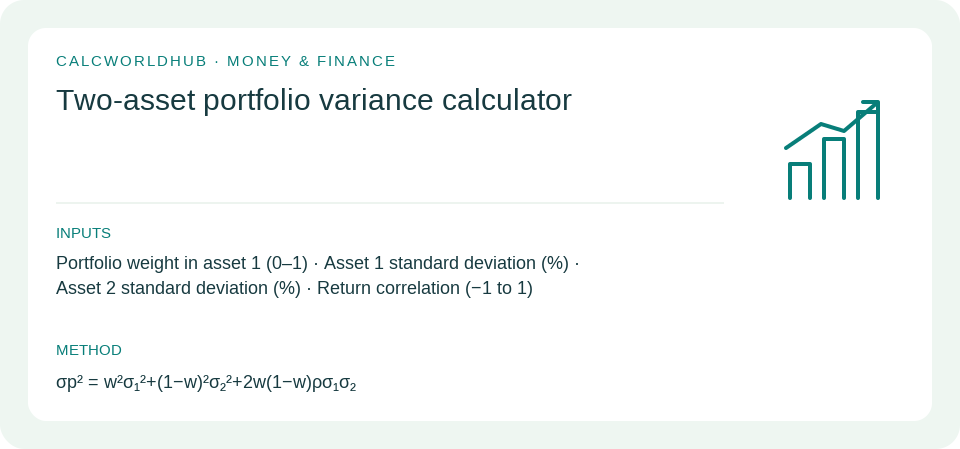
How to use this calculator
Calculate two-asset portfolio return variance from weights, standard deviations, and correlation.
- Enter Portfolio weight in asset 1 (0–1), Asset 1 standard deviation (%), Asset 2 standard deviation (%), Return correlation (−1 to 1). Match the units shown beside each field and review the result together with the assumptions below.
- Read the worked example below to check the expected input format and result.
- Compare another scenario by changing one input at a time. Use Reset to return to the starting values.
Two-asset portfolio variance calculator
Calculate two-asset portfolio return variance from weights, standard deviations, and correlation.
Inputs and units
- Portfolio weight in asset 1 (0–1): Fraction invested in asset 1; asset 2 receives the complement, so weights sum to one.
- Asset 1 standard deviation (%): Return volatility as a percentage for the same horizon; the formula converts it to a fraction internally.
- Asset 2 standard deviation (%): Return volatility as a percentage for the same horizon; the formula converts it to a fraction internally.
- Return correlation (−1 to 1): Return correlation between assets, bounded from −1 to 1; it determines the covariance contribution.
Formula and method
σp² = w²σ₁²+(1−w)²σ₂²+2w(1−w)ρσ₁σ₂
Worked example
For w=0.6, σ₁=18%, σ₂=10%, ρ=0.25, variance=0.015424 when returns are represented as fractions.
Interpreting the result
Variance is in squared-return units; a lower correlation can reduce portfolio risk, while negative covariance may provide diversification.
Assumptions and limits
Weight is 0–1, standard deviations are nonnegative, and correlation is −1 to 1. Inputs must share a return period; estimates do not guarantee future covariance.
Sources and method
- Explains weighted returns, covariance/correlation and portfolio volatility; the companion CAPM section gives the beta-based expected return relation. OpenStax Principles of Finance: risk and return to multiple assets
Frequently asked questions
Which inputs determine this result?
The visible inputs are Portfolio weight in asset 1 (0–1), Asset 1 standard deviation (%), Asset 2 standard deviation (%), Return correlation (−1 to 1). Each is used by the displayed formula; the calculator does not use any other hidden measurement.
When does this method apply?
Weight is 0–1, standard deviations are nonnegative, and correlation is −1 to 1. Inputs must share a return period; estimates do not guarantee future covariance.
How do I use the Two-asset portfolio variance calculator?
Enter Portfolio weight in asset 1 (0–1), Asset 1 standard deviation (%), Asset 2 standard deviation (%), Return correlation (−1 to 1). Match the units shown beside each field and review the result together with the assumptions below.
What is a worked example of Two-asset portfolio variance?
For w=0.6, σ₁=18%, σ₂=10%, ρ=0.25, variance=0.015424 when returns are represented as fractions.
What does the Two-asset portfolio variance calculator calculate?
Calculate two-asset portfolio return variance from weights, standard deviations, and correlation.
See the calculation methodology.
Good calculators show their work.
CalcWorldHub is built around clear inputs and visible assumptions. Results are estimates for planning; check official sources or your provider’s terms when exact figures matter.