Two-asset portfolio volatility calculator
Convert the two-asset portfolio variance model into standard deviation.
Calculator
How to use this calculator
Convert the two-asset portfolio variance model into standard deviation.
- Enter Portfolio weight in asset 1 (0–1), Asset 1 standard deviation (%), Asset 2 standard deviation (%), Return correlation (−1 to 1). Match the units shown beside each field and review the result together with the assumptions below.
- Read the worked example below to check the expected input format and result.
- Compare another scenario by changing one input at a time. Use Reset to return to the starting values.
Two-asset portfolio volatility calculator
Convert the two-asset portfolio variance model into standard deviation.
Inputs and units
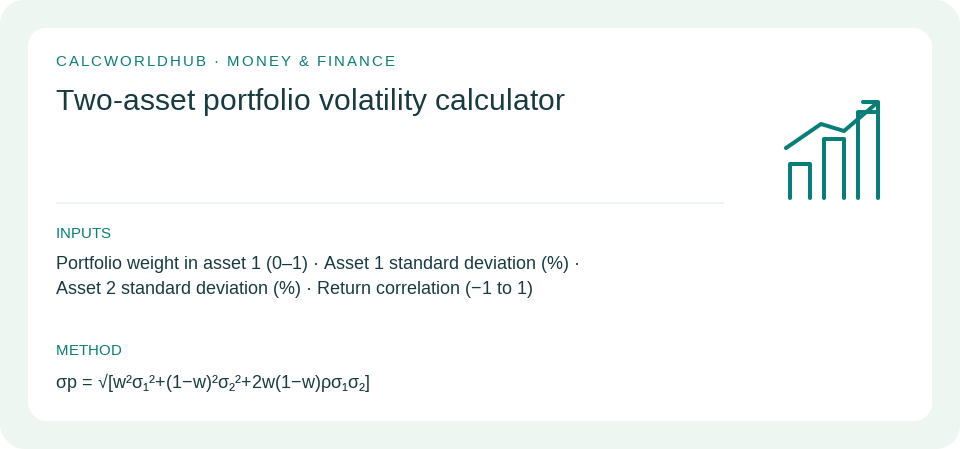
- Portfolio weight in asset 1 (0–1): Fraction invested in asset 1; asset 2 receives the complement, so weights sum to one.
- Asset 1 standard deviation (%): Return volatility as a percentage for the same horizon; the formula converts it to a fraction internally.
- Asset 2 standard deviation (%): Return volatility as a percentage for the same horizon; the formula converts it to a fraction internally.
- Return correlation (−1 to 1): Return correlation between assets, bounded from −1 to 1; it determines the covariance contribution.
Formula and method
σp = √[w²σ₁²+(1−w)²σ₂²+2w(1−w)ρσ₁σ₂]
Worked example
For w=0.6, σ₁=18%, σ₂=10%, and ρ=0.25, volatility is √0.015424≈0.12419=12.42%.
Interpreting the result
Volatility is the square root of variance and is reported as a percentage using the entered percentage standard deviations.
Assumptions and limits
Weight must be 0–1, standard deviations nonnegative, and correlation −1 to 1. The formula assumes inputs cover the same horizon and uses historical/estimated parameters as supplied.
Sources and method
- Explains weighted returns, covariance/correlation and portfolio volatility; the companion CAPM section gives the beta-based expected return relation. OpenStax Principles of Finance: risk and return to multiple assets
Frequently asked questions
Which inputs determine this result?
The visible inputs are Portfolio weight in asset 1 (0–1), Asset 1 standard deviation (%), Asset 2 standard deviation (%), Return correlation (−1 to 1). Each is used by the displayed formula; the calculator does not use any other hidden measurement.
When does this method apply?
Weight must be 0–1, standard deviations nonnegative, and correlation −1 to 1. The formula assumes inputs cover the same horizon and uses historical/estimated parameters as supplied.
How do I use the Two-asset portfolio volatility calculator?
Enter Portfolio weight in asset 1 (0–1), Asset 1 standard deviation (%), Asset 2 standard deviation (%), Return correlation (−1 to 1). Match the units shown beside each field and review the result together with the assumptions below.
What is a worked example of Two-asset portfolio volatility?
For w=0.6, σ₁=18%, σ₂=10%, and ρ=0.25, volatility is √0.015424≈0.12419=12.42%.
What does the Two-asset portfolio volatility calculator calculate?
Convert the two-asset portfolio variance model into standard deviation.
See the calculation methodology.
Good calculators show their work.
CalcWorldHub is built around clear inputs and visible assumptions. Results are estimates for planning; check official sources or your provider’s terms when exact figures matter.