How to use this calculator
Estimate the average heat-transfer coefficient on an isothermal plate washed by an unobstructed parallel flow.
- Enter Free-stream speed parallel to plate (m/s), Plate length in flow direction (m), Plate width (m), Fluid kinematic viscosity (m²/s), then complete the remaining labeled fields. Match the units shown beside each field and review the result together with the assumptions below.
- Read the worked example below to check the expected input format and result.
- Compare another scenario by changing one input at a time. Use Reset to return to the starting values.
Isothermal flat plate external forced convection explained
For laminar flow over an isothermal flat plate, the average Nusselt correlation estimates heat transfer across the plate length. Reynolds number, Prandtl number, and the specified one-face area determine the reported coefficient and heat rate; the correlation is not a turbulent-flow model.
Inputs, symbols, and units
U— Free-stream speed parallel to plate (m/s)- Free-stream speed parallel to plate (m/s). Enter the value for this state; the units shown are used without an unstated conversion.
L— Plate length in flow direction (m)- Plate length in flow direction (m). Enter the value for this state; the units shown are used without an unstated conversion.
W— Plate width (m)- Plate width (m). Enter the value for this state; the units shown are used without an unstated conversion.
nu— Fluid kinematic viscosity (m²/s)- Fluid kinematic viscosity (m²/s). Enter the value for this state; the units shown are used without an unstated conversion.
Pr— Fluid Prandtl number- Fluid Prandtl number. Enter the value for this state; the units shown are used without an unstated conversion.
kf— Fluid conductivity (W/m/K)- Fluid conductivity (W/m/K). Enter the value for this state; the units shown are used without an unstated conversion.
Ts— Uniform plate temperature (°C)- Uniform plate temperature (°C). Enter the value for this state; the units shown are used without an unstated conversion.
Ta— Free-stream temperature (°C)- Free-stream temperature (°C). Enter the value for this state; the units shown are used without an unstated conversion.
Formula and method
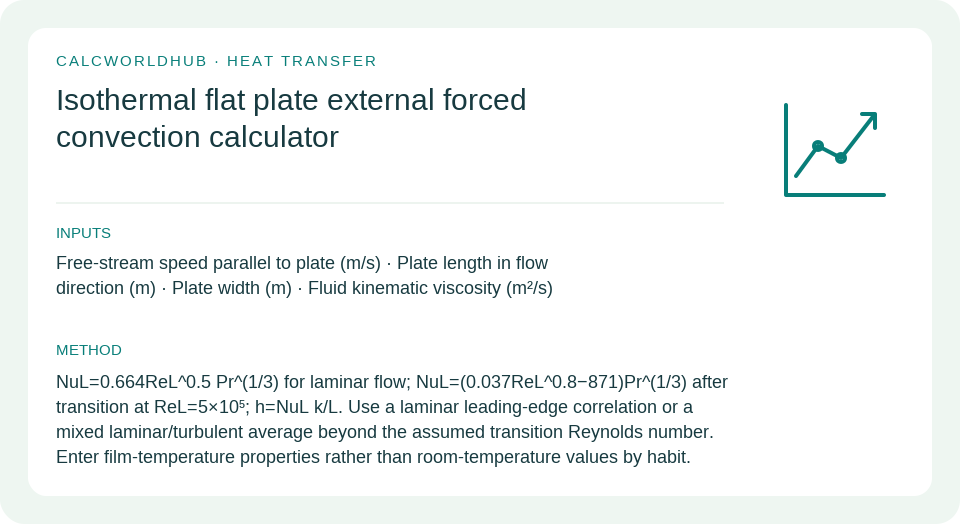
NuL=0.664ReL^0.5 Pr^(1/3) for laminar flow; NuL=(0.037ReL^0.8−871)Pr^(1/3) after transition at ReL=5×10⁵; h=NuL k/L.
Use a laminar leading-edge correlation or a mixed laminar/turbulent average beyond the assumed transition Reynolds number. Enter film-temperature properties rather than room-temperature values by habit.
A worked scenario
Free-stream speed parallel to plate (m/s) = 5; Plate length in flow direction (m) = 0.5; Plate width (m) = 0.3; Fluid kinematic viscosity (m²/s) = 0.000016; Fluid Prandtl number = 0.71; Fluid conductivity (W/m/K) = 0.027; Uniform plate temperature (°C) = 60; Free-stream temperature (°C) = 20.
- Average convection coefficient: 12.644198 W/m²/K
- One-face convection heat rate: 75.86519 W
- Length Reynolds number: 156250
- Average Nusselt number: 234.151822
Air at 5 m/s flows along a 0.5 by 0.3 m isothermal plate with the entered properties. Reynolds number is 156,250; the laminar correlation gives average h=12.6442 W/m²/K and a 75.8652 W heat rate for a 40 K temperature difference.
Assumptions and edge cases
Smooth flat plate, zero pressure gradient, negligible buoyancy and radiation, 0.6≤Pr≤60 and ReL≤10⁷. Transition is modeled at 5×10⁵ rather than measured.
Reading the outputs
Average h applies to one face over the full plate length; heat rate is signed surface-to-fluid. Re and Nu document the selected regime.
Frequently asked questions
Why can local h differ from the reported average?
The boundary layer thickens downstream; this page averages from the leading edge to L.
Do I multiply by two for two exposed faces?
Only if both faces have equivalent independent flow and thermal conditions.
Will a turbulent inlet change transition?
Yes. The fixed transition assumption may then be inappropriate.
How do I use the Isothermal flat plate external forced convection calculator?
Enter Free-stream speed parallel to plate (m/s), Plate length in flow direction (m), Plate width (m), Fluid kinematic viscosity (m²/s), then complete the remaining labeled fields. Match the units shown beside each field and review the result together with the assumptions below.
What is a worked example of Isothermal flat plate external forced convection?
Free-stream speed parallel to plate (m/s) = 5; Plate length in flow direction (m) = 0.5; Plate width (m) = 0.3; Fluid kinematic viscosity (m²/s) = 0.000016; Fluid Prandtl number = 0.71; Fluid conductivity (W/m/K) = 0.027; Uniform plate temperature (°C) = 60; Free-stream temperature (°C) = 20. Average convection coefficient: 12.644198 W/m²/K One-face convection heat rate: 75.86519 W Length Reynolds number: 156250 Average Nusselt number: 234.151822 Air at 5 m/s flows along a 0.5 by 0.3 m isothermal plate with the entered properties. Reynolds number is 156,250; the laminar correlation gives average h=12.6442 W/m²/K and a 75.8652 W heat rate for a 40 K temperature difference.
Background or definition reference: IIT NPTEL forced convection over a flat plate.
Read our calculation methodology.