How to use this calculator
Measure ordinal association from concordant and discordant observation pairs with the tau-b correction for ties.
- Enter First variable, Matching second variable. Match the units shown beside each field and review the result together with the assumptions below.
- Read the worked example below to check the expected input format and result.
- Compare another scenario by changing one input at a time. Use Reset to return to the starting values.
Kendall tau b rank association with ties explained
Enter paired observations in matching positions; τ-b compares concordant and discordant pairs and adjusts its denominator for ties in either variable.
How the calculation works
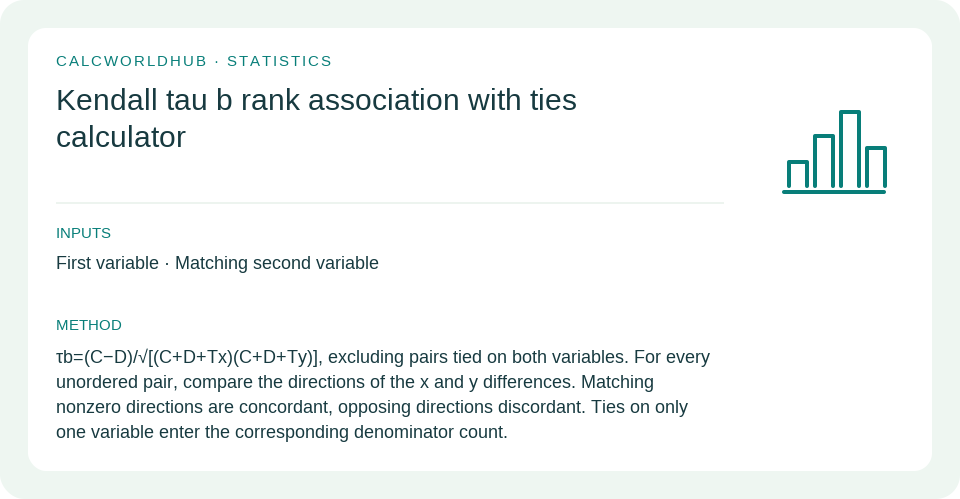
τb=(C−D)/√[(C+D+Tx)(C+D+Ty)], excluding pairs tied on both variables.
For every unordered pair, compare the directions of the x and y differences. Matching nonzero directions are concordant, opposing directions discordant. Ties on only one variable enter the corresponding denominator count.
Set up the calculation
x— First variable- Ordered values in the role named above. Match row positions with other lists and use a consistent measurement unit within the same variable. Use comma-separated values in the stated order.
y— Matching second variable- Ordered values in the role named above. Match row positions with other lists and use a consistent measurement unit within the same variable. Use comma-separated values in the stated order.
Limits of this model
2–2,000 matched observations with rank variation in both variables. This page reports the coefficient and pair counts, not a p-value. Dependence or repeated measurements require separate inferential handling.
Check this example
First variable = 1,2,2,3,4,5; Matching second variable = 2,1,3,3,5,4.
- Kendall tau-b: 0.64285714
- Concordant pairs: 11
- Discordant pairs: 2
- Ties only in x: 1
- Ties only in y: 1
The second and third x values tie while their y values differ, so that pair affects tie correction rather than concordance. A y tie at three produces a different tie category.
Reading the outputs
Tau-b ranges from minus one to one. Its pair-count meaning differs from Pearson’s linear correlation and Spearman’s correlation of average ranks.
Frequently asked questions
Are tied ranks allowed?
Yes. Tau-b explicitly adjusts for pairs tied only in one variable.
Does tau-b measure linearity?
No. It measures ordinal concordance.
Why is no significance result shown?
Tie-aware variance and sampling design require additional inference; the coefficient is provided without an unlabelled approximation.
How do I use the Kendall tau b rank association with ties calculator?
Enter First variable, Matching second variable. Match the units shown beside each field and review the result together with the assumptions below.
What is a worked example of Kendall tau b rank association with ties?
First variable = 1,2,2,3,4,5; Matching second variable = 2,1,3,3,5,4. Kendall tau-b: 0.64285714 Concordant pairs: 11 Discordant pairs: 2 Ties only in x: 1 Ties only in y: 1 The second and third x values tie while their y values differ, so that pair affects tie correction rather than concordance. A y tie at three produces a different tie category.
Method reference: SciPy statistical function reference.
Read our calculation methodology.