How to use this calculator
Combine a normal prior for a mean with normally distributed observations whose population standard deviation is treated as known.
- Enter Observed sample mean, Sample size, Known observation standard deviation, Prior mean, then complete the remaining labeled fields. Match the units shown beside each field and review the result together with the assumptions below.
- Read the worked example below to check the expected input format and result.
- Compare another scenario by changing one input at a time. Use Reset to return to the starting values.
Known variance normal mean Bayesian update explained
With a normal prior and known observation variance, a sample mean contributes precision in proportion to sample size. The posterior mean is a precision-weighted combination of prior and observed means.
Inputs, symbols, and units
mean— Observed sample mean- Sample arithmetic mean in the original observation unit.
n— Sample size- Number of independent observations summarized by the sample mean. Enter a whole number.
sigma— Known observation standard deviation- Known population SD of individual observations, not the standard error of their mean.
m0— Prior mean- Prior center for the unknown population mean, in observation units.
tau— Prior mean standard deviation- Prior SD of the unknown mean, in observation units. It describes mean uncertainty rather than individual spread.
level— Credible probability- Probability coverage for the labeled interval, expressed as a fraction such as 0.95 rather than 95. The article distinguishes confidence from posterior credibility.
Formula and method
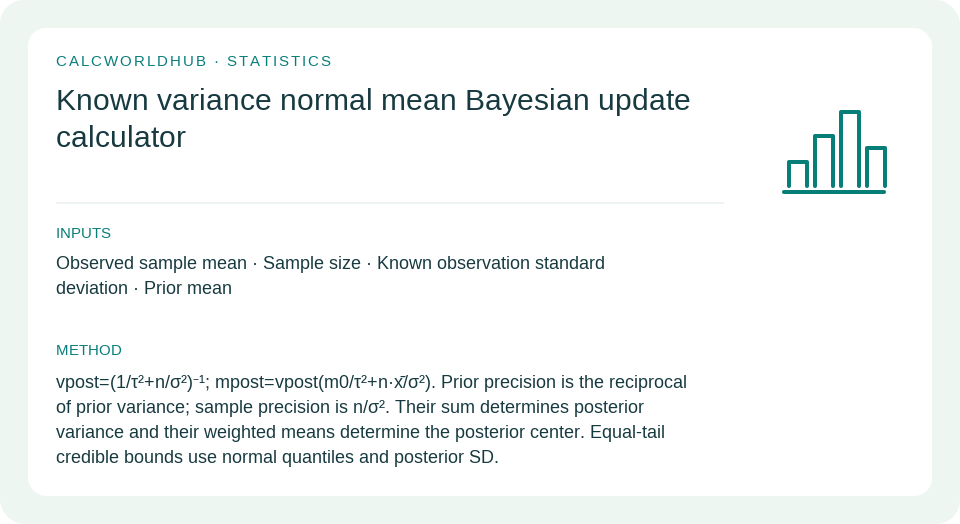
vpost=(1/τ²+n/σ²)⁻¹; mpost=vpost(m0/τ²+n·x̄/σ²).
Prior precision is the reciprocal of prior variance; sample precision is n/σ². Their sum determines posterior variance and their weighted means determine the posterior center. Equal-tail credible bounds use normal quantiles and posterior SD.
A worked scenario
Observed sample mean = 104; Sample size = 16; Known observation standard deviation = 12; Prior mean = 100; Prior mean standard deviation = 5; Credible probability = 0.95.
- Posterior mean: 102.94117647 data units
- Posterior standard deviation: 2.57247878 data units
- Credible lower bound: 97.89921071 data units
- Credible upper bound: 107.98314223 data units
The sample mean of 104 has standard error 12/√16=3. The prior SD is five, so the sample receives more precision weight than the prior, while both influence the posterior.
Assumptions and edge cases
Known population observation variance, independent normal sampling, and a proper normal prior. Replacing known σ with a noisy sample SD changes the model; this tool does not integrate uncertainty in σ.
Reading the outputs
Posterior SD measures uncertainty about the mean, not spread of individual future observations. Credible bounds use that mean uncertainty only.
Frequently asked questions
Is tau the population SD?
No. Tau describes prior uncertainty in the unknown mean; sigma describes individual observations.
Can I use this for unknown variance?
That requires another prior/model, such as a normal-inverse-gamma analysis.
Does a larger sample always move the center toward its mean?
With the other inputs fixed, increasing n gives the sample more precision weight.
How do I use the Known variance normal mean Bayesian update calculator?
Enter Observed sample mean, Sample size, Known observation standard deviation, Prior mean, then complete the remaining labeled fields. Match the units shown beside each field and review the result together with the assumptions below.
What is a worked example of Known variance normal mean Bayesian update?
Observed sample mean = 104; Sample size = 16; Known observation standard deviation = 12; Prior mean = 100; Prior mean standard deviation = 5; Credible probability = 0.95. Posterior mean: 102.94117647 data units Posterior standard deviation: 2.57247878 data units Credible lower bound: 97.89921071 data units Credible upper bound: 107.98314223 data units The sample mean of 104 has standard error 12/√16=3. The prior SD is five, so the sample receives more precision weight than the prior, while both influence the posterior.
Method reference: SciPy statistical function reference.
Read our calculation methodology.