How to use this calculator
Update a constant Poisson event rate with a gamma prior and estimate credible rate bounds and future event expectations.
- Enter Observed event count, Observed exposure, Prior gamma shape, Prior gamma rate, then complete the remaining labeled fields. Match the units shown beside each field and review the result together with the assumptions below.
- Read the worked example below to check the expected input format and result.
- Compare another scenario by changing one input at a time. Use Reset to return to the starting values.
Gamma Poisson event rate posterior explained
Use Observed event count with Observed exposure to reproduce the sample calculation, then review the stated limits before carrying the result into another scenario.
A numerical walkthrough
Observed event count = 14; Observed exposure = 8; Prior gamma shape = 2; Prior gamma rate = 1; Credible probability = 0.95; Future exposure = 3.
- Posterior mean event rate: 1.77777778 events/exposure unit
- Equal-tail credible lower rate: 1.01615361 events/exposure unit
- Equal-tail credible upper rate: 2.74891321 events/exposure unit
- Expected future event count: 5.33333333 events
- Predictive probability of zero future events: 0.0100226
Fourteen events over eight exposure units update Gamma(2, rate 1) to Gamma(16, rate 9). The future interval has three exposure units and shares the same uncertain rate.
The model behind the numbers
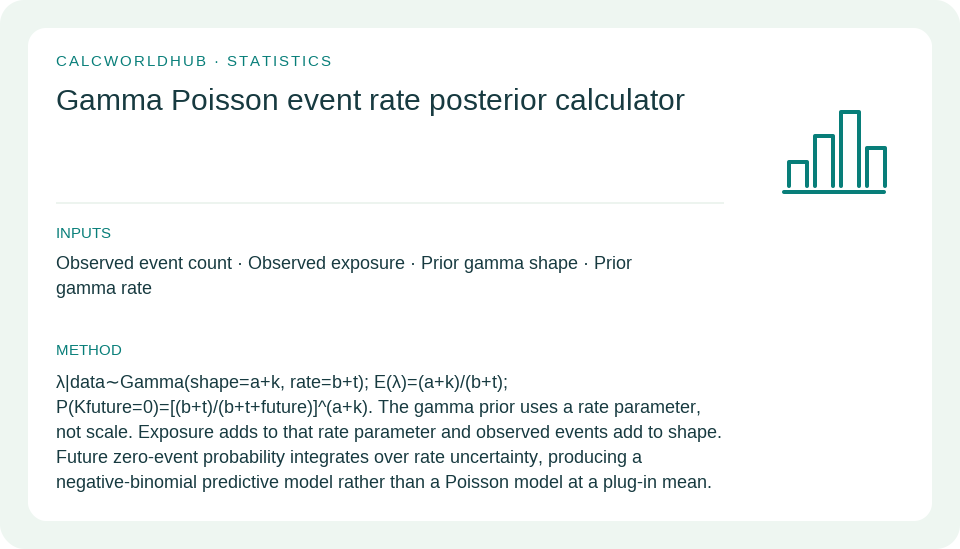
λ|data∼Gamma(shape=a+k, rate=b+t); E(λ)=(a+k)/(b+t); P(Kfuture=0)=[(b+t)/(b+t+future)]^(a+k).
The gamma prior uses a rate parameter, not scale. Exposure adds to that rate parameter and observed events add to shape. Future zero-event probability integrates over rate uncertainty, producing a negative-binomial predictive model rather than a Poisson model at a plug-in mean.
What to enter
k— Observed event count- Whole event count observed during exposure t. Multiple events per exposure unit are allowed by the Poisson model. Enter a whole number.
t— Observed exposure- Positive observed exposure, such as machine-hours. Its unit determines the rate unit.
a— Prior gamma shape- Positive gamma prior shape for the uncertain event rate.
b— Prior gamma rate- Positive gamma prior rate parameter, with the same exposure unit as t. If a prior scale is known, convert it to its reciprocal.
level— Credible probability- Probability coverage for the labeled interval, expressed as a fraction such as 0.95 rather than 95. The article distinguishes confidence from posterior credibility.
future— Future exposure- Future exposure in the same unit as observed exposure. Zero gives zero expected future events.
Interpreting the result
Independent Poisson counts with constant rate per exposure unit and known exposure. Exposure units must agree for observed data, prior rate, and future period. Overdispersion or time-varying rates are outside this model.
Reading the outputs
Posterior bounds are rates, while expected future events are counts. The zero-event probability includes both event randomness and posterior rate uncertainty.
Frequently asked questions
Is prior b a scale?
No. It is a rate parameter; scale would be 1/b.
Can exposure be person-hours or machine-hours?
Yes, provided every exposure quantity and prior use the same unit.
Why not exp(−posterior mean×future)?
That plugs in a fixed rate and ignores posterior rate uncertainty.
How do I use the Gamma Poisson event rate posterior calculator?
Enter Observed event count, Observed exposure, Prior gamma shape, Prior gamma rate, then complete the remaining labeled fields. Match the units shown beside each field and review the result together with the assumptions below.
What is a worked example of Gamma Poisson event rate posterior?
Observed event count = 14; Observed exposure = 8; Prior gamma shape = 2; Prior gamma rate = 1; Credible probability = 0.95; Future exposure = 3. Posterior mean event rate: 1.77777778 events/exposure unit Equal-tail credible lower rate: 1.01615361 events/exposure unit Equal-tail credible upper rate: 2.74891321 events/exposure unit Expected future event count: 5.33333333 events Predictive probability of zero future events: 0.0100226 Fourteen events over eight exposure units update Gamma(2, rate 1) to Gamma(16, rate 9). The future interval has three exposure units and shares the same uncertain rate.
Method reference: SciPy gamma distribution, shape and scale.
Read our calculation methodology.