How to use this calculator
Account for a developing temperature boundary layer in laminar flow through an isothermal circular tube.
- Enter Mean tube speed (m/s), Tube inside diameter (m), Heated tube length (m), Kinematic viscosity (m²/s), then complete the remaining labeled fields. Match the units shown beside each field and review the result together with the assumptions below.
- Read the worked example below to check the expected input format and result.
- Compare another scenario by changing one input at a time. Use Reset to return to the starting values.
Laminar circular tube thermal entrance convection explained
The Graetz number combines Reynolds number, Prandtl number, tube diameter, and heated length to account for thermal entrance effects in laminar internal flow. The average Nusselt correlation then gives the convection coefficient from fluid conductivity and tube diameter.
Inputs, symbols, and units
U— Mean tube speed (m/s)- Mean tube speed (m/s). Enter the value for this state; the units shown are used without an unstated conversion.
D— Tube inside diameter (m)- Tube inside diameter (m). Enter the value for this state; the units shown are used without an unstated conversion.
L— Heated tube length (m)- Heated tube length (m). Enter the value for this state; the units shown are used without an unstated conversion.
nu— Kinematic viscosity (m²/s)- Kinematic viscosity (m²/s). Enter the value for this state; the units shown are used without an unstated conversion.
Pr— Fluid Prandtl number- Fluid Prandtl number. Enter the value for this state; the units shown are used without an unstated conversion.
kf— Fluid conductivity (W/m/K)- Fluid conductivity (W/m/K). Enter the value for this state; the units shown are used without an unstated conversion.
Formula and method
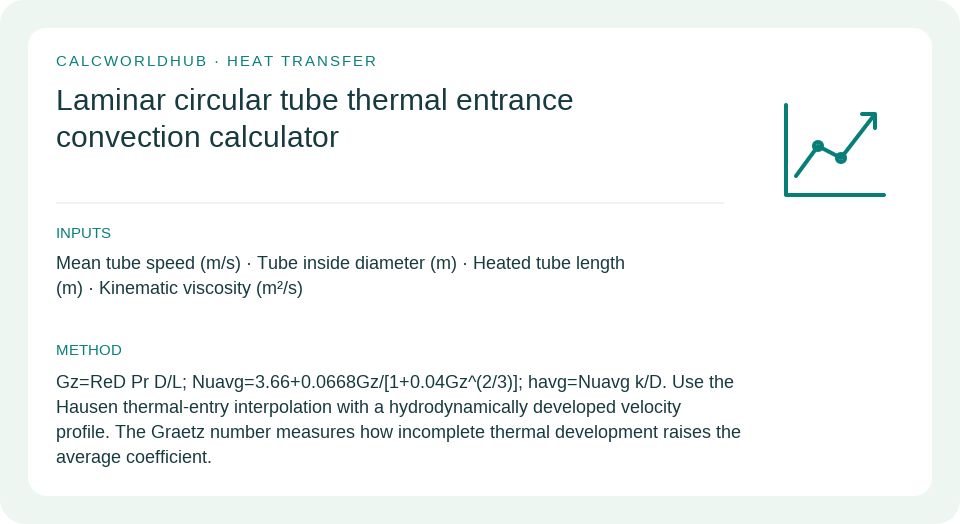
Gz=ReD Pr D/L; Nuavg=3.66+0.0668Gz/[1+0.04Gz^(2/3)]; havg=Nuavg k/D.
Use the Hausen thermal-entry interpolation with a hydrodynamically developed velocity profile. The Graetz number measures how incomplete thermal development raises the average coefficient.
A worked scenario
Mean tube speed (m/s) = 0.05; Tube inside diameter (m) = 0.01; Heated tube length (m) = 0.5; Kinematic viscosity (m²/s) = 0.000001; Fluid Prandtl number = 7; Fluid conductivity (W/m/K) = 0.6.
- Average thermal-entry coefficient: 386.659694 W/m²/K
- Average Nusselt number: 6.444328
- Graetz number: 70
- Diameter Reynolds number: 500
At 0.05 m/s in a 10 mm diameter, 0.5 m long tube, the supplied liquid has Reynolds number 500 and Graetz number 70. The mean entrance-region Nusselt number is 6.44433, giving h=386.660 W/m²/K, above the fully developed 3.66 limit.
Assumptions and edge cases
Laminar Newtonian flow, constant wall temperature, developed velocity profile and modest property variation; Re<2300 and 0.1≤Pr≤1000. Not a simultaneous hydrodynamic entrance calculation.
Reading the outputs
Reports average h, Nu, Graetz and Reynolds numbers for the specified heated length.
Frequently asked questions
Why can Nu exceed 3.66?
Near the thermal inlet the boundary layer is thin; averaging a finite heated length retains that enhancement.
Can I use uniform heat flux at the wall?
No. That boundary condition has a different fully developed limit and entry correlation.
Does increasing tube length increase average h?
At fixed flow it generally reduces entrance enhancement toward the fully developed limit.
How do I use the Laminar circular tube thermal entrance convection calculator?
Enter Mean tube speed (m/s), Tube inside diameter (m), Heated tube length (m), Kinematic viscosity (m²/s), then complete the remaining labeled fields. Match the units shown beside each field and review the result together with the assumptions below.
What is a worked example of Laminar circular tube thermal entrance convection?
Mean tube speed (m/s) = 0.05; Tube inside diameter (m) = 0.01; Heated tube length (m) = 0.5; Kinematic viscosity (m²/s) = 0.000001; Fluid Prandtl number = 7; Fluid conductivity (W/m/K) = 0.6. Average thermal-entry coefficient: 386.659694 W/m²/K Average Nusselt number: 6.444328 Graetz number: 70 Diameter Reynolds number: 500 At 0.05 m/s in a 10 mm diameter, 0.5 m long tube, the supplied liquid has Reynolds number 500 and Graetz number 70. The mean entrance-region Nusselt number is 6.44433, giving h=386.660 W/m²/K, above the fully developed 3.66 limit.
Background or definition reference: IIT NPTEL tube forced-convection correlations.
Read our calculation methodology.