How to use this calculator
Estimate the Langelier Saturation Index from pH, temperature, dissolved solids, calcium hardness, and alkalinity.
- Enter Measured pH, Total dissolved solids (mg/L), Water temperature (°C), Calcium hardness as CaCO3 (mg/L), then complete the remaining labeled fields. Match the units shown beside each field and review the result together with the assumptions below.
- Read the worked example below to check the expected input format and result.
- Compare another scenario by changing one input at a time. Use Reset to return to the starting values.
How this calculation works
The Langelier Saturation Index compares measured pH with the estimated pH at calcium-carbonate saturation. Its empirical factor calculation uses total dissolved solids, temperature, calcium hardness, and alkalinity, with hardness and alkalinity expressed as calcium carbonate.
Inputs and units
ph— Measured pH- Measured pH of the water sample.
tds— Total dissolved solids (mg/L)- TDS concentration in milligrams per liter.
temperatureC— Water temperature (°C)- Sample temperature in degrees Celsius.
calciumHardness— Calcium hardness as CaCO3 (mg/L)- Calcium hardness concentration expressed as calcium carbonate.
alkalinity— Total alkalinity as CaCO3 (mg/L)- Total alkalinity expressed as calcium carbonate.
Formula
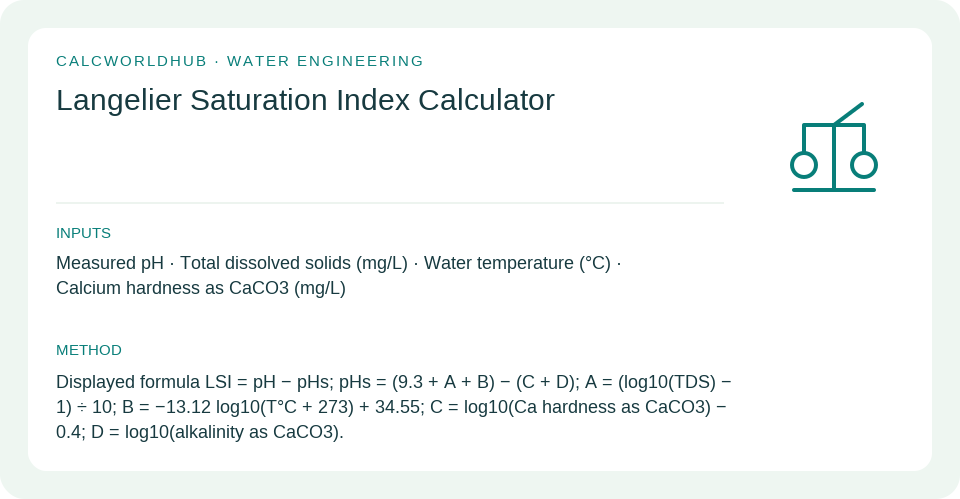
LSI = pH − pHs; pHs = (9.3 + A + B) − (C + D); A = (log10(TDS) − 1) ÷ 10; B = −13.12 log10(T°C + 273) + 34.55; C = log10(Ca hardness as CaCO3) − 0.4; D = log10(alkalinity as CaCO3).
Method
Enter pH, TDS in mg/L, temperature in °C, calcium hardness in mg/L as CaCO3, and total alkalinity in mg/L as CaCO3. The positive chemistry values are converted to base-10 logarithms in the saturation-pH estimate.
Worked example
For pH 7.20, TDS 400 mg/L, temperature 20 °C, calcium hardness 240 mg/L as CaCO3, and alkalinity 196 mg/L as CaCO3, pHs is about 7.372 and LSI is about −0.172.
Assumptions and limits
The LSI is an indicator of calcium-carbonate saturation tendency, not a complete corrosion, scaling, or water-safety prediction. The estimate does not model ionic strength, other dissolved species, treatment chemistry, surface conditions, or system operation; use appropriate water-quality analysis for decisions.
Frequently asked questions
What does a negative LSI indicate?
It indicates measured pH is below the calculated calcium-carbonate saturation pH under this empirical model.
Which units should I use for hardness and alkalinity?
Enter both in mg/L expressed as CaCO3, as required by this form of the equation.
Does LSI predict all types of corrosion?
No. It is a calcium-carbonate saturation index and does not include every water chemistry or system factor.
How do I use the Langelier Saturation Index Calculator?
Enter Measured pH, Total dissolved solids (mg/L), Water temperature (°C), Calcium hardness as CaCO3 (mg/L), then complete the remaining labeled fields. Match the units shown beside each field and review the result together with the assumptions below.
What is a worked example of Langelier Saturation Index?
For pH 7.20, TDS 400 mg/L, temperature 20 °C, calcium hardness 240 mg/L as CaCO3, and alkalinity 196 mg/L as CaCO3, pHs is about 7.372 and LSI is about −0.172.
Reference: U.S. EPA small-community water guide describing the Langelier Saturation Index equation. See our calculation methodology.