How to use this calculator
Split P and total alkalinity into hydroxide, carbonate, and bicarbonate equivalents.
- Enter Phenolphthalein alkalinity, P (mg/L as CaCO₃), Total alkalinity, T (mg/L as CaCO₃). Match the units shown beside each field and review the result together with the assumptions below.
- Read the worked example below to check the expected input format and result.
- Compare another scenario by changing one input at a time. Use Reset to return to the starting values.
How this calculation works
Enter phenolphthalein alkalinity (P) and total alkalinity (T), both reported as mg/L CaCO₃. The classic P/T relationships estimate the hydroxide, carbonate, and bicarbonate portions as calcium-carbonate equivalents.
Inputs and units
pAlkalinityMgLCaCO3— Phenolphthalein alkalinity, P (mg/L as CaCO₃)- Alkalinity measured to the phenolphthalein endpoint, conventionally pH 8.3.
totalAlkalinityMgLCaCO3— Total alkalinity, T (mg/L as CaCO₃)- Total alkalinity measured to the specified final endpoint; use the same sample and reporting basis as P.
Formula
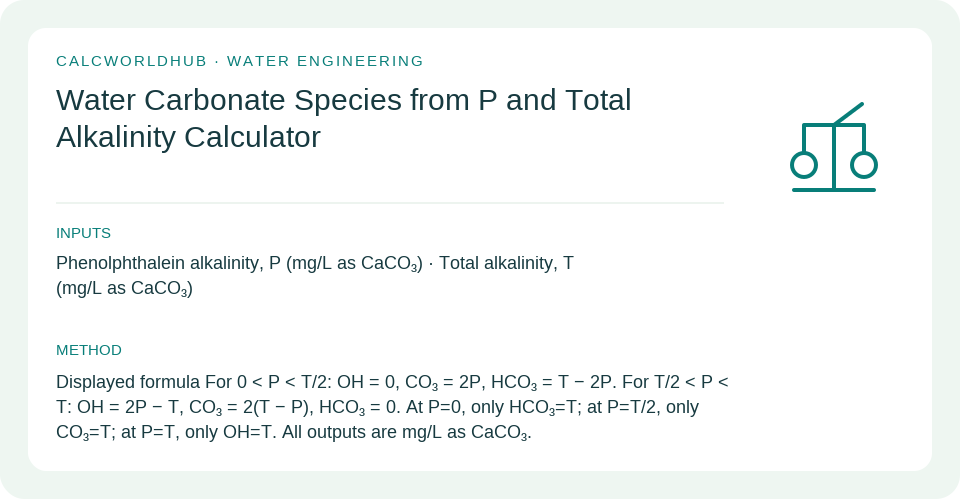
For 0 < P < T/2: OH = 0, CO₃ = 2P, HCO₃ = T − 2P. For T/2 < P < T: OH = 2P − T, CO₃ = 2(T − P), HCO₃ = 0. At P=0, only HCO₃=T; at P=T/2, only CO₃=T; at P=T, only OH=T. All outputs are mg/L as CaCO₃.
Method
Compare phenolphthalein alkalinity P with half of total alkalinity T, then apply the matching stoichiometric case. The equations partition measured alkalinity into three principal species on a CaCO₃-equivalent basis.
Worked example
For P = 30 mg/L and T = 120 mg/L as CaCO₃, P is below T/2, so hydroxide alkalinity is 0, carbonate alkalinity is 2 × 30 = 60 mg/L, and bicarbonate alkalinity is 120 − 60 = 60 mg/L as CaCO₃.
Assumptions and limits
The P/T classification assumes hydroxide, carbonate, and bicarbonate are the principal contributors to alkalinity. Other weak-acid systems, such as substantial phosphate, silicate, borate, or organic alkalinity, can make the inferred species split inaccurate. This calculation does not replace a full chemical speciation analysis.
Frequently asked questions
What do P and T mean?
P is phenolphthalein alkalinity and T is total alkalinity; both must use the same mg/L as CaCO₃ basis.
Are the results actual ion mass concentrations?
No. The three values are alkalinity contributions expressed as equivalent CaCO₃ concentrations, matching the classic P/T table.
When can this species split be misleading?
Other acid-base systems can contribute to the measured endpoints, so the three-species assumption may not represent samples with substantial non-carbonate alkalinity.
How do I use the Water Carbonate Species from P and Total Alkalinity Calculator?
Enter Phenolphthalein alkalinity, P (mg/L as CaCO₃), Total alkalinity, T (mg/L as CaCO₃). Match the units shown beside each field and review the result together with the assumptions below.
What is a worked example of Water Carbonate Species from P and Total Alkalinity?
For P = 30 mg/L and T = 120 mg/L as CaCO₃, P is below T/2, so hydroxide alkalinity is 0, carbonate alkalinity is 2 × 30 = 60 mg/L, and bicarbonate alkalinity is 120 − 60 = 60 mg/L as CaCO₃.
Reference: APHA Standard Methods 2320.II P and total alkalinity species relationships. See our calculation methodology.