How to use this calculator
Calculate total alkalinity as CaCO₃ from acid titrant volume, normality, and sample volume at the selected endpoint.
- Enter Standard acid titrant, A (mL), Acid normality, N (eq/L), Water sample volume, Vₛ (mL). Match the units shown beside each field and review the result together with the assumptions below.
- Read the worked example below to check the expected input format and result.
- Compare another scenario by changing one input at a time. Use Reset to return to the starting values.
How this calculation works
Enter the standardized acid volume used to titrate a water aliquot to the chosen endpoint, the acid normality, and the original sample volume. The calculator reports total alkalinity as calcium carbonate and in milliequivalents per liter.
Inputs and units
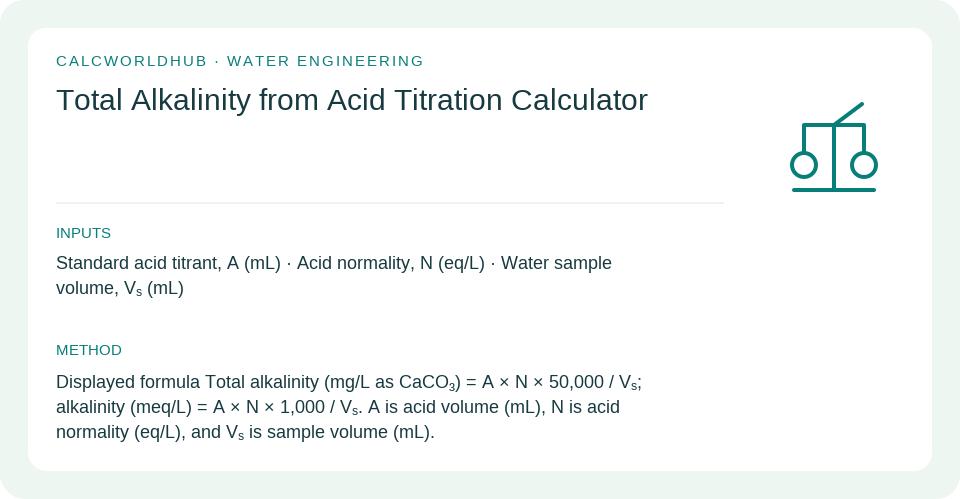
acidTitrantVolumeMl— Standard acid titrant, A (mL)- Total standardized acid volume consumed to the selected endpoint; use the endpoint required by your method.
acidNormalityEqL— Acid normality, N (eq/L)- Normality of the standardized acid titrant in equivalents per liter; must be positive.
sampleVolumeMl— Water sample volume, Vₛ (mL)- Original water aliquot volume before titration; must be positive.
Formula
Total alkalinity (mg/L as CaCO₃) = A × N × 50,000 / Vₛ; alkalinity (meq/L) = A × N × 1,000 / Vₛ. A is acid volume (mL), N is acid normality (eq/L), and Vₛ is sample volume (mL).
Method
Convert the acid consumed at the stated endpoint to milliequivalents per liter, then express the result as an equivalent mass concentration of calcium carbonate using 50 mg/meq.
Worked example
For 3.56 mL of 0.020 eq/L acid consumed by a 50 mL aliquot, total alkalinity is 3.56 × 0.020 × 50,000 / 50 = 71.2 mg/L as CaCO₃, or 1.424 meq/L.
Assumptions and limits
This fixed-endpoint reduction assumes standardized acid and a valid analytical endpoint, commonly pH 4.5 for total alkalinity. It does not interpret the full titration curve or speciate carbonate, bicarbonate, or hydroxide. Follow the selected method, especially for very low alkalinity or noncarbonate contributors.
Frequently asked questions
What does “as CaCO₃” mean?
It expresses the sample’s acid-neutralizing capacity as the equivalent mass concentration of calcium carbonate; it does not mean all alkalinity is present as dissolved calcium carbonate.
Which titration endpoint should I use?
Use the endpoint specified by the analytical procedure. A pH near 4.5 is commonly used for total alkalinity, but very low-alkalinity samples may require a different protocol.
Does the result identify carbonate and bicarbonate separately?
No. This single-endpoint calculation reports total alkalinity only and does not fit a titration curve or calculate species concentrations.
How do I use the Total Alkalinity from Acid Titration Calculator?
Enter Standard acid titrant, A (mL), Acid normality, N (eq/L), Water sample volume, Vₛ (mL). Match the units shown beside each field and review the result together with the assumptions below.
What is a worked example of Total Alkalinity from Acid Titration?
For 3.56 mL of 0.020 eq/L acid consumed by a 50 mL aliquot, total alkalinity is 3.56 × 0.020 × 50,000 / 50 = 71.2 mg/L as CaCO₃, or 1.424 meq/L.
Reference: U.S. EPA Method 310.1 potentiometric alkalinity titration and calcium-carbonate reporting equation. See our calculation methodology.