How to use this calculator
Solve reversible ideal-gas compression or expansion when heat capacity changes linearly with temperature.
- Enter Initial temperature (K), Initial absolute pressure (kPa), Final absolute pressure (kPa), cp(T)=a+bT intercept (kJ/kg/K), then complete the remaining labeled fields. Match the units shown beside each field and review the result together with the assumptions below.
- Read the worked example below to check the expected input format and result.
- Compare another scenario by changing one input at a time. Use Reset to return to the starting values.
Linear heat-capacity ideal-gas isentropic state explained
Solve reversible ideal-gas compression or expansion when heat capacity changes linearly with temperature.
How the calculation works
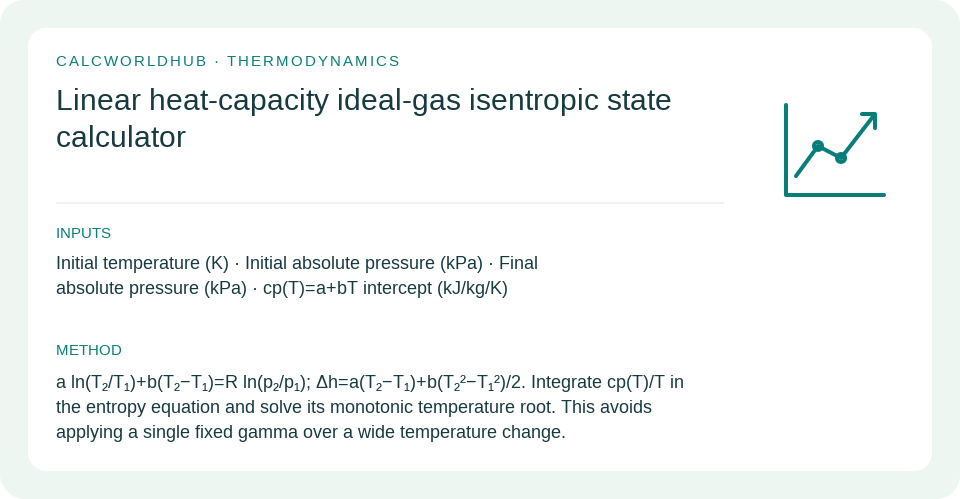
a ln(T₂/T₁)+b(T₂−T₁)=R ln(p₂/p₁); Δh=a(T₂−T₁)+b(T₂²−T₁²)/2.
Integrate cp(T)/T in the entropy equation and solve its monotonic temperature root. This avoids applying a single fixed gamma over a wide temperature change.
Set up the calculation
T1— Initial temperature (K)- Initial absolute temperature for the reversible pressure change.
p1— Initial absolute pressure (kPa)- Initial absolute pressure; the entropy equation uses the ratio p2/p1.
p2— Final absolute pressure (kPa)- Final absolute pressure. Values above p1 model compression; values below p1 model expansion.
a— cp(T)=a+bT intercept (kJ/kg/K)- Intercept in the fitted mass-specific heat capacity cp(T)=a+bT; the model requires a>R.
b— cp temperature slope (kJ/kg/K²)- Nonnegative temperature slope of cp(T), in kJ/(kg·K²); b=0 reduces the model to constant cp=a.
R— Specific gas constant (kJ/kg/K)- Specific gas constant on the same mass basis and units as cp(T).
Limits of this model
Ideal gas with fitted cp=a+bT, nonnegative slope and a>R. Root bracket is 10⁻⁶–10⁵ K for numerical screening, not a claim of physical property validity.
Check this example
Initial temperature (K) = 300; Initial absolute pressure (kPa) = 100; Final absolute pressure (kPa) = 1000; cp(T)=a+bT intercept (kJ/kg/K) = 0.95; cp temperature slope (kJ/kg/K²) = 0.00015; Specific gas constant (kJ/kg/K) = 0.287.
- Final isentropic temperature: 575.851624 K
- Specific enthalpy change: 280.179425 kJ/kg
- Final cp: 1.036378 kJ/kg/K
Compressing an ideal gas from 100 to 1,000 kPa at 300 K with cp(T)=0.95+0.00015T kJ/kg/K gives 575.852 K and 280.179 kJ/kg enthalpy rise. The increasing heat capacity prevents use of one constant-gamma power law.
Reading the outputs
Returns final kelvin temperature, signed enthalpy change and endpoint heat capacity.
Frequently asked questions
Does b=0 reproduce constant-cp compression?
Yes. The integral reduces to cp ln(T2/T1)=R ln(p2/p1).
Can it model an irreversible compressor?
No. This is the isentropic reference state; apply component efficiency separately.
How should a and b be chosen?
Fit reliable gas heat-capacity data only over the temperature interval of interest.
How do I use the Linear heat-capacity ideal-gas isentropic state calculator?
Enter Initial temperature (K), Initial absolute pressure (kPa), Final absolute pressure (kPa), cp(T)=a+bT intercept (kJ/kg/K), then complete the remaining labeled fields. Match the units shown beside each field and review the result together with the assumptions below.
What is a worked example of Linear heat-capacity ideal-gas isentropic state?
Initial temperature (K) = 300; Initial absolute pressure (kPa) = 100; Final absolute pressure (kPa) = 1000; cp(T)=a+bT intercept (kJ/kg/K) = 0.95; cp temperature slope (kJ/kg/K²) = 0.00015; Specific gas constant (kJ/kg/K) = 0.287. Final isentropic temperature: 575.851624 K Specific enthalpy change: 280.179425 kJ/kg Final cp: 1.036378 kJ/kg/K Compressing an ideal gas from 100 to 1,000 kPa at 300 K with cp(T)=0.95+0.00015T kJ/kg/K gives 575.852 K and 280.179 kJ/kg enthalpy rise. The increasing heat capacity prevents use of one constant-gamma power law.
Background or definition reference: NASA Glenn ideal gas compression and expansion.
Read our calculation methodology.