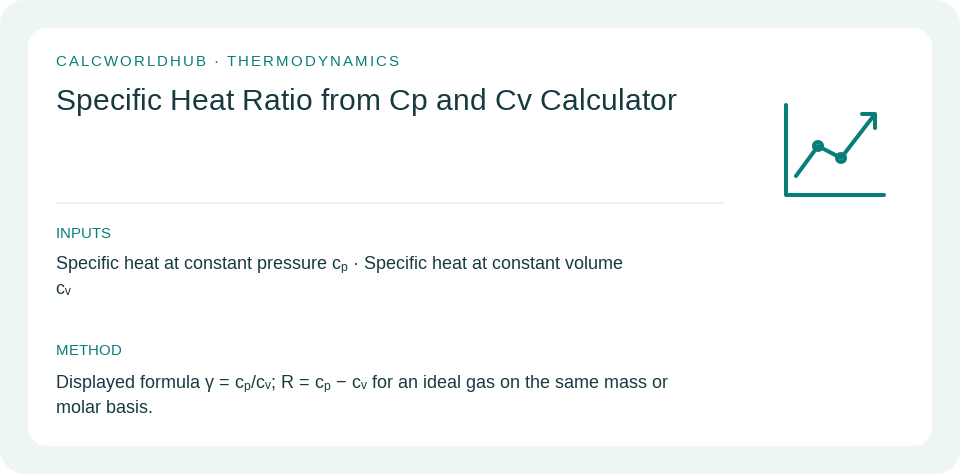
How to use this calculator
Find the ideal-gas specific heat ratio γ from heat capacities at constant pressure and volume.
- Enter Specific heat at constant pressure cₚ, Specific heat at constant volume cᵥ. Match the units shown beside each field and review the result together with the assumptions below.
- Read the worked example below to check the expected input format and result.
- Compare another scenario by changing one input at a time. Use Reset to return to the starting values.
How this calculation works
The specific heat ratio appears in ideal-gas isentropic flow, sound-speed, and compression relationships. Because the ratio is formed from two heat capacities, their units and mass or molar basis must match.
Inputs and units
cp— Specific heat at constant pressure cₚ- Heat capacity per unit mass or mole at constant pressure, in a chosen consistent unit such as J/(kg·K).
cv— Specific heat at constant volume cᵥ- Heat capacity on the same mass or molar basis and in the same units as cₚ; for an ideal gas cₚ must exceed cᵥ.
Formula
γ = cₚ/cᵥ; R = cₚ − cᵥ for an ideal gas on the same mass or molar basis.
Method
Enter heat capacity at constant pressure and heat capacity at constant volume using the same units and basis. Divide cₚ by cᵥ to obtain γ; their difference is also reported as the ideal-gas specific gas constant on that basis.
Worked example
For air values cₚ = 1,005 J/(kg·K) and cᵥ = 718 J/(kg·K), γ = 1,005/718 ≈ 1.3997 and R = 1,005 − 718 = 287 J/(kg·K).
Assumptions and limits
This uses the ideal-gas relation cₚ − cᵥ = R and treats both heat capacities as constant at the entered state. Real-gas effects and temperature-dependent heat capacities can change the ratio; use properties appropriate to the gas and temperature range.
Frequently asked questions
What does the specific heat ratio describe?
It is cₚ divided by cᵥ and is used in ideal-gas isentropic relations, sound-speed equations, and compressible-flow calculations.
Why must both heat capacities use the same basis?
A mass-specific value cannot be divided consistently by a molar value. Convert both to the same units per kilogram or per mole first.
Is γ always 1.4 for air?
No. That is a common approximation near ordinary conditions; heat capacities vary with temperature and gas composition.
What does cₚ − cᵥ return?
For an ideal gas it equals the specific gas constant R on the same mass or molar basis as the inputs.
How do I use the Specific Heat Ratio from Cp and Cv Calculator?
Enter Specific heat at constant pressure cₚ, Specific heat at constant volume cᵥ. Match the units shown beside each field and review the result together with the assumptions below.
Reference: NASA Glenn standard atmosphere model. See our calculation methodology.