How to use this calculator
Estimate the annualized borrowing rate when an upfront origination fee reduces the cash received but scheduled payments use the full principal.
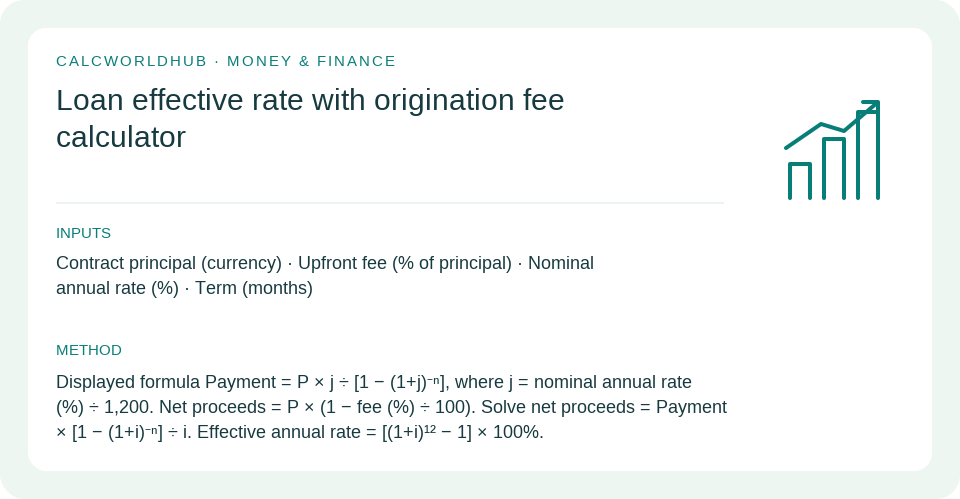
- Enter Contract principal (currency), Upfront fee (% of principal), Nominal annual rate (%), Term (months). Match the units shown beside each field and review the result together with the assumptions below.
- Read the worked example below to check the expected input format and result.
- Compare another scenario by changing one input at a time. Use Reset to return to the starting values.
How this calculation works
A fee-financed loan can have a higher effective cost than its stated nominal rate because the borrower receives less cash while repaying the contracted balance. This estimate solves a monthly internal rate from net proceeds and equal monthly payments, then annualizes it.
Inputs and units
principal— Contract principal (currency)- Amount on which the scheduled payment is based.
fee— Upfront fee (% of principal)- Fee withheld from proceeds at origination.
annual— Nominal annual rate (%)- Stated nominal annual interest rate, compounded monthly.
months— Term (months)- Number of equal monthly payments.
Formula
Payment = P × j ÷ [1 − (1+j)⁻ⁿ], where j = nominal annual rate (%) ÷ 1,200. Net proceeds = P × (1 − fee (%) ÷ 100). Solve net proceeds = Payment × [1 − (1+i)⁻ⁿ] ÷ i. Effective annual rate = [(1+i)¹² − 1] × 100%.
Worked example
For a $10,000 loan, 3% upfront fee, 12% nominal annual rate, and 24 monthly payments, payment is about $470.73, net proceeds are $9,700, and the cash-flow effective annual rate is about 16.18%. The rate is solved numerically from the annuity cash flows.
Assumptions and limits
This is a simplified cash-flow effective rate, not a jurisdiction-specific legal APR disclosure. Assumes one upfront fee, monthly end-of-period payments, fixed nominal rate, no other fees, and no irregular dates.
Frequently asked questions
Is this the legal APR?
No. Legal APR rules can include specific fee, timing, and disclosure conventions; this is a clearly scoped monthly cash-flow estimate.
Why does the fee raise the effective rate?
The same payments are made after receiving less than the contract principal as net proceeds.
What if the fee is zero?
The solved monthly rate matches the payment rate, and the annualized effective rate reflects monthly compounding.
How do I use the Loan effective rate with origination fee calculator?
Enter Contract principal (currency), Upfront fee (% of principal), Nominal annual rate (%), Term (months). Match the units shown beside each field and review the result together with the assumptions below.
What is a worked example of Loan effective rate with origination fee?
For a $10,000 loan, 3% upfront fee, 12% nominal annual rate, and 24 monthly payments, payment is about $470.73, net proceeds are $9,700, and the cash-flow effective annual rate is about 16.18%. The rate is solved numerically from the annuity cash flows.
Read our calculation methodology.