Logistic population growth calculator
Project population under a logistic model that slows as it approaches a carrying capacity.
Calculator
How to use this calculator
Project population under a logistic model that slows as it approaches a carrying capacity.
- Enter Initial population N₀, Carrying capacity K, Growth rate r, Time units t. Match the units shown beside each field and review the result together with the assumptions below.
- Read the worked example below to check the expected input format and result.
- Compare another scenario by changing one input at a time. Use Reset to return to the starting values.
Logistic population growth calculator
Project population under a logistic model that slows as it approaches a carrying capacity.
What it measures
Growth is initially near exponential when population is small relative to capacity, then levels off as the remaining capacity shrinks.
Inputs and units
- Initial population N₀: Initial population N₀; positive and below carrying capacity for growth toward K.
- Carrying capacity K: Carrying capacity K; greater than N₀ in this growth scenario.
- Growth rate r: Intrinsic rate r per chosen time unit.
- Time units t: Elapsed time in the same units used for r.
Formula and method
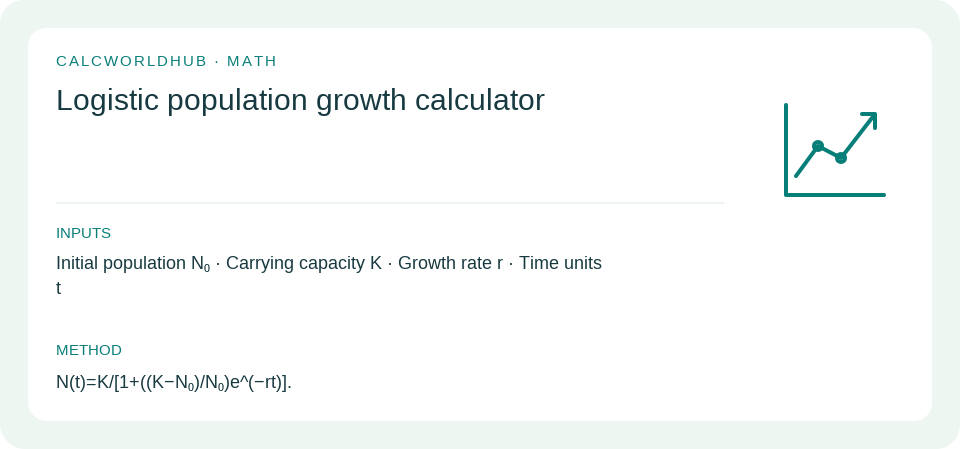
N(t)=K/[1+((K−N₀)/N₀)e^(−rt)].
Worked example
N₀=100, K=1,000, r=0.4, t=5 gives N(5)≈450.85 model units.
Interpreting the result
The value is a continuous-model estimate. It is not rounded to a whole organism because the equation describes a smooth expected trajectory.
Assumptions and limits
Assumes a fixed carrying capacity and constant intrinsic growth rate in the chosen time unit. Real populations may have changing resources, migration, age structure, or stochastic variation.
Frequently asked questions
Why does growth slow near K?
The logistic model reduces growth as the population uses more of its finite modeled capacity.
Is K a guaranteed maximum?
It is a model parameter, not a fixed real-world ceiling.
How do I use the Logistic population growth calculator?
Enter Initial population N₀, Carrying capacity K, Growth rate r, Time units t. Match the units shown beside each field and review the result together with the assumptions below.
What is a worked example of Logistic population growth?
N₀=100, K=1,000, r=0.4, t=5 gives N(5)≈450.85 model units.
What does the Logistic population growth calculator calculate?
Project population under a logistic model that slows as it approaches a carrying capacity.
See the calculation methodology.
Good calculators show their work.
CalcWorldHub is built around clear inputs and visible assumptions. Results are estimates for planning; check official sources or your provider’s terms when exact figures matter.