Logistic time to target population calculator
Estimate when a logistic population reaches a target size below its carrying capacity. Enter your values below to see the result and method.
inputs.
Related calculators
Compare the logistic time-to-target result with population growth and doubling calculations that answer different parts of the same model.
How to use this calculator
Estimate when a logistic population reaches a target size below its carrying capacity.
- Enter Carrying capacity K (organisms), Initial population N₀ (organisms), Intrinsic growth rate r (per day), Target population N (organisms). Match the units shown beside each field and review the result together with the assumptions below.
- Read the worked example below to check the expected input format and result.
- Compare another scenario by changing one input at a time. Use Reset to return to the starting values.
Choose the population model and time window
Use this page to answer a population or culture question under a stated model. Estimate when a logistic population reaches a target size below its carrying capacity.
Inputs and units
Use one population unit for K, N₀, and target N; r is per time unit. Keep 0<N₀<N<K for positive growth toward an attainable target.
- Carrying capacity K (organisms): The model's limiting population under the assumed fixed resource conditions.
- Initial population N₀ (organisms): Population at time zero, in the same count unit as K and target N.
- Intrinsic growth rate r (per day): Continuous growth rate per day; its time basis determines the answer's time unit.
- Target population N (organisms): The population to reach; positive growth from below requires N₀ < N < K.
Population equation and checked example
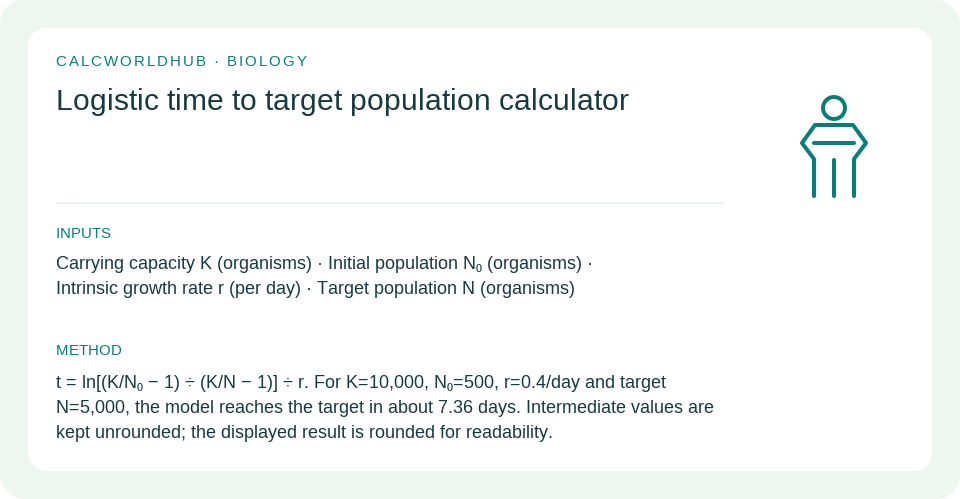
t = ln[(K/N₀ − 1) ÷ (K/N − 1)] ÷ r.
For K=10,000, N₀=500, r=0.4/day and target N=5,000, the model reaches the target in about 7.36 days.
Intermediate values are kept unrounded; the displayed result is rounded for readability.
Reading a population estimate
A population model is only as useful as its boundary conditions. Compare its assumptions with the sampling interval and whether the culture is closed, resource-limited, or exposed to a treatment.
Assumptions and limitations
Requires 0<N₀<N<K and r>0. Logistic parameters must remain stable over the modeled interval.
Frequently asked questions
What does carrying capacity K mean?
K is the model’s limiting population under the assumed resource and environmental conditions; it is not a forecast if those conditions change.
Can a logistic population reach K in finite time?
With positive growth and an initial population below K, the ideal logistic curve approaches K asymptotically. A target equal to or above K has no finite positive-growth solution.
What units does the answer use?
The time uses the reciprocal of the rate-constant time unit. If r is entered per day, the answer is in days.
How do I use the Logistic time to target population calculator?
Enter Carrying capacity K (organisms), Initial population N₀ (organisms), Intrinsic growth rate r (per day), Target population N (organisms). Match the units shown beside each field and review the result together with the assumptions below.
What is a worked example of Logistic time to target population?
t = ln[(K/N₀ − 1) ÷ (K/N − 1)] ÷ r. For K=10,000, N₀=500, r=0.4/day and target N=5,000, the model reaches the target in about 7.36 days. Intermediate values are kept unrounded; the displayed result is rounded for readability.
Read the calculation methodology and privacy policy.