Lot acceptance probability calculator
Estimate the chance a sample plan accepts a lot at an entered defect rate. Enter your values below for a free estimate, with no account required.
inputs.
Calculator


How to use the Lot acceptance probability calculator
Set the process defect fraction p, sample size n, and acceptance number c from the single-sample plan. The result is P(X ≤ c) for X distributed as Binomial(n, p). Keep the defect definition and inspection unit consistent with the plan.
Inputs and units
- Assumed defective fraction (%) Enter a percentage from 0 to 100; for example, 5 means p = 0.05 in the binomial model.
- Sample size (n) Enter a whole number of inspected items from 1 to 500.
- Accept lot if defective count is at most (c) Enter a whole number from 0 to n. Items with more than c defectives cause rejection.
Formula and example
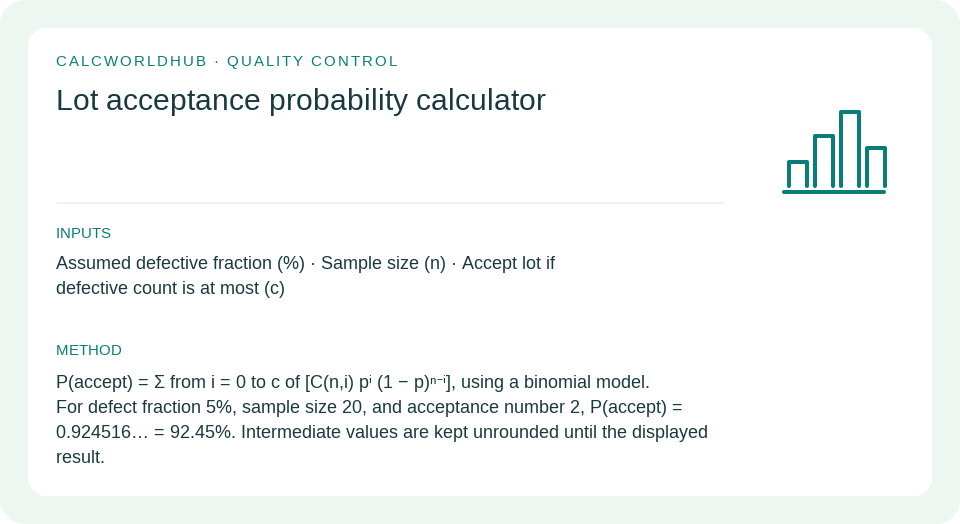
P(accept) = Σ from i = 0 to c of [C(n,i) pⁱ (1 − p)ⁿ⁻ⁱ], using a binomial model.
For defect fraction 5%, sample size 20, and acceptance number 2, P(accept) = 0.924516… = 92.45%. Intermediate values are kept unrounded until the displayed result.
How to interpret the result
At a 5% defect fraction, n = 20, and c = 2, the plan accepts about 92.45% of repeated samples. This is the plan’s operating probability at the assumed defect rate; it does not mean that 92.45% of the lot is good. Compare this probability across plausible defect rates before choosing a plan.
Assumptions and limits
The binomial model treats sample draws as independent with a stable defect probability. For sampling without replacement when the sample is a meaningful share of a finite lot, a hypergeometric model may be more suitable. NIST describes the binomial operating-characteristic probability for single-sample plans in its sampling-plan guidance.
Frequently asked questions
What does acceptance number mean?
It is the maximum number of defective sample items allowed for acceptance; this is an entered plan parameter, not chosen by the calculator.
Does 92.45% acceptance probability mean the lot is 92.45% good?
No. It is the chance that this sample plan accepts a lot at the assumed defect fraction.
Does the model apply to sampling without replacement?
The binomial model assumes independent draws with a stable defect probability. For a large sample relative to a finite lot, a hypergeometric model may be more suitable.
How do I use the Lot acceptance probability calculator?
Enter Assumed defective fraction (%), Sample size (n), Accept lot if defective count is at most (c). Match the units shown beside each field and review the result together with the assumptions below.
What is a worked example of Lot acceptance probability?
P(accept) = Σ from i = 0 to c of [C(n,i) pⁱ (1 − p)ⁿ⁻ⁱ], using a binomial model. For defect fraction 5%, sample size 20, and acceptance number 2, P(accept) = 0.924516… = 92.45%. Intermediate values are kept unrounded until the displayed result.
Read the calculation methodology and privacy policy.
Good calculators show their work.
CalcWorldHub is built around clear inputs and visible assumptions. Results are estimates for planning; check official sources or your provider’s terms when exact figures matter.