M/M/1 probability of n customers calculator
Find the steady-state probability that an M/M/1 queue contains exactly n customers.
How to use this calculator
Find the steady-state probability that an M/M/1 queue contains exactly n customers.
- Enter Arrival rate λ, Service rate μ, Number in system n. Match the units shown beside each field and review the result together with the assumptions below.
- Read the worked example below to check the expected input format and result.
- Compare another scenario by changing one input at a time. Use Reset to return to the starting values.
How the M/M/1 probability of n customers calculator works
Find the steady-state probability that an M/M/1 queue contains exactly n customers.
Inputs and units
- Arrival rate λ: Arrival rate λ is customers per time unit and must be nonnegative.
- Service rate μ: Service rate μ is customers served per same time unit and must exceed λ.
- Number in system n: n is a whole nonnegative count in the system, including service.
Formula and method
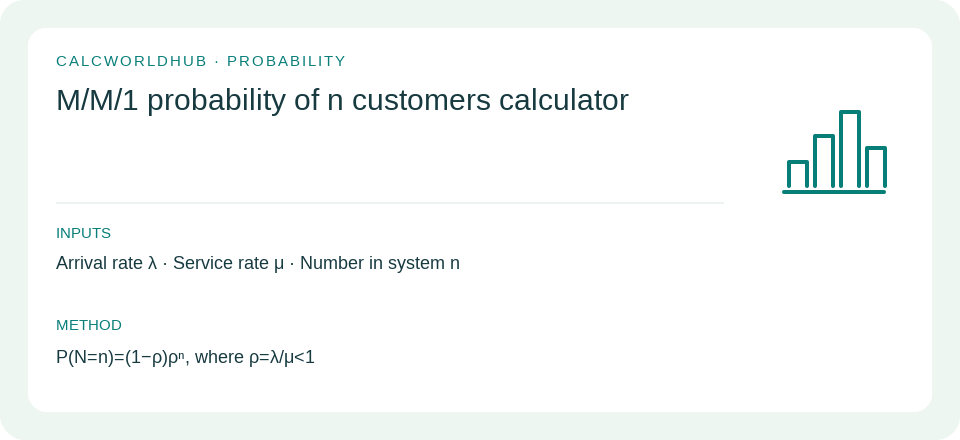
P(N=n)=(1−ρ)ρⁿ, where ρ=λ/μ<1
Worked example
For λ=4 customers/hour and μ=5/hour, ρ=0.8; P(N=3)=0.2×0.8³=0.1024.
Interpreting the result
This is the long-run fraction of observations with n customers in the system, including any customer being served.
Assumptions and limits
The model assumes Poisson arrivals, exponential service times, one server, a stable queue λ<μ, and a sufficiently long-run stationary regime.
Frequently asked questions
Does n include the customer in service?
Yes. N counts everyone in the system, both waiting and being served.
Why must service rate exceed arrival rate?
If λ≥μ, the queue has no finite stationary distribution in the basic M/M/1 model.
How do I use the M/M/1 probability of n customers calculator?
Enter Arrival rate λ, Service rate μ, Number in system n. Match the units shown beside each field and review the result together with the assumptions below.
What is a worked example of M/M/1 probability of n customers?
For λ=4 customers/hour and μ=5/hour, ρ=0.8; P(N=3)=0.2×0.8³=0.1024.
What does the M/M/1 probability of n customers calculator calculate?
Find the steady-state probability that an M/M/1 queue contains exactly n customers.
See the calculation methodology.