How to use this calculator
Estimate average waiting and queue length for a single-server M/M/1 system below its stability limit.
- Enter Arrival rate (customers/hour), Service rate (customers/hour). Match the units shown beside each field and review the result together with the assumptions below.
- Read the worked example below to check the expected input format and result.
- Compare another scenario by changing one input at a time. Use Reset to return to the starting values.
M M 1 queue waiting time explained
An M/M/1 queue has one server, Poisson arrivals and exponential service times. A finite steady-state average requires arrivals below service capacity. Waiting before service and total time in the system are separate outputs, with corresponding queue and system populations.
Example with entered values
Arrival rate (customers/hour) = 8; Service rate (customers/hour) = 10.
- Mean waiting before service: 24 minutes
- Mean time in system: 30 minutes
- Mean number waiting: 3.2 customers
- Server utilization: 80 %
The inputs above are an illustrative scenario. Display values are rounded after the calculation.
The calculation behind the result
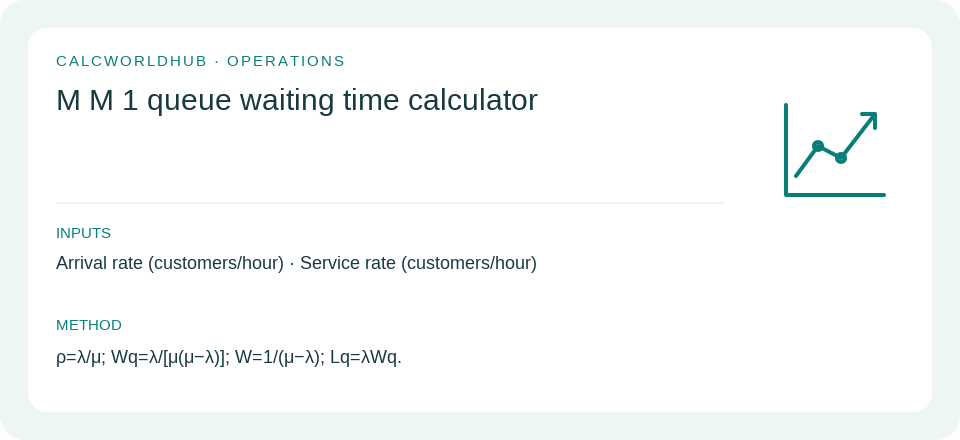
ρ=λ/μ; Wq=λ/[μ(μ−λ)]; W=1/(μ−λ); Lq=λWq.
Inputs and units
- Arrival rate (customers/hour)
- Mean Poisson arrival rate.
- Service rate (customers/hour)
- One server’s mean exponential service rate.
Before interpreting the result
Assumes independent Poisson arrivals, exponential service, one server, unlimited waiting space, and steady operation.
Little’s law relates measured averages without a service-time distribution. M/M/1 predicts averages under explicit arrival and service assumptions.
Consolidated queue measures
This tool also includes the former separate pages for M/M/1 utilization, stability, system size, queue length, waiting time, empty-system probability, and arrival waiting probability. For the example λ=8/hour and μ=10/hour, utilization is 80%, mean system population is 4, the empty probability is 0.2, and an arrival waits with probability 0.8.
ρ=λ/μ; Wq=λ/[μ(μ−λ)]; W=1/(μ−λ); Lq=λWq; L=λW; P0=1−ρ; P(arrival waits)=ρ, requiring λ<μ.
Frequently asked questions
What if arrivals equal service capacity?
No finite steady-state mean exists in this model.
Is service time assumed constant?
No. It is exponentially distributed.
Does the waiting result include service?
The main result excludes service; total system time is shown separately.
How do I use the M M 1 queue waiting time calculator?
Enter Arrival rate (customers/hour), Service rate (customers/hour). Match the units shown beside each field and review the result together with the assumptions below.
What is a worked example of M M 1 queue waiting time?
Arrival rate (customers/hour) = 8; Service rate (customers/hour) = 10. Mean waiting before service: 24 minutes Mean time in system: 30 minutes Mean number waiting: 3.2 customers Server utilization: 80 % The inputs above are an illustrative scenario. Display values are rounded after the calculation.
Method reference: MIT queueing models (checked October 15, 2026).
See our calculation methodology.