How to use this calculator
Model a pooled queue with several identical servers, reporting wait probability, average delay, and a target-time service level.
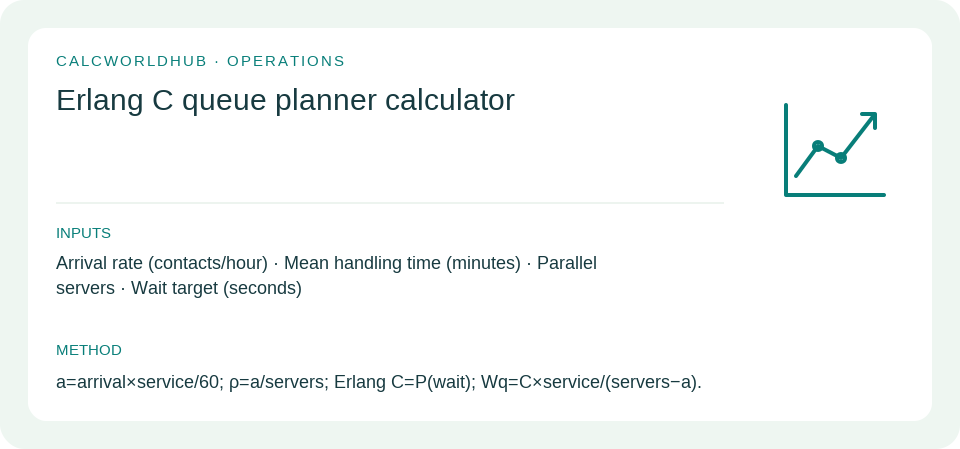
- Enter Arrival rate (contacts/hour), Mean handling time (minutes), Parallel servers, Wait target (seconds). Match the units shown beside each field and review the result together with the assumptions below.
- Read the worked example below to check the expected input format and result.
- Compare another scenario by changing one input at a time. Use Reset to return to the starting values.
Erlang C queue planner explained
Erlang C estimates delay in a stable, shared queue with Poisson arrivals, exponential service times, identical servers, and no abandonment. Arrival rate and mean handling time determine offered load; server count determines the modeled wait probability and service level.
Inputs and units
- Arrival rate (contacts/hour)
- Average independent arrival rate.
- Mean handling time (minutes)
- Mean service duration per contact.
- Parallel servers
- Identical simultaneously available servers.
- Wait target (seconds)
- Threshold used for the modeled service level.
Formula and method
a=arrival×service/60; ρ=a/servers; Erlang C=P(wait); Wq=C×service/(servers−a).
A worked example
Arrival rate (contacts/hour) = 20; Mean handling time (minutes) = 6; Parallel servers = 3; Wait target (seconds) = 60.
- Probability of waiting: 44.444 %
- Average wait: 2.667 minutes
- Answered within target: 62.379 %
- Occupancy: 66.67 %
The inputs above are an illustrative scenario. Display values are rounded after the calculation.
Assumptions and special cases
Assumes Poisson arrivals, exponential handling, unlimited patience, no abandonment, and stable staffing. Schedule shrinkage is excluded.
M/M/1 has a single server. Erlang C handles a shared queue with multiple parallel servers.
Frequently asked questions
Does this include abandonment?
No. Erlang C assumes callers keep waiting.
Should I enter scheduled headcount?
Enter simultaneously available servers after any shrinkage adjustment.
Can occupancy reach 100%?
A finite steady-state result requires occupancy below 100%.
How do I use the Erlang C queue planner calculator?
Enter Arrival rate (contacts/hour), Mean handling time (minutes), Parallel servers, Wait target (seconds). Match the units shown beside each field and review the result together with the assumptions below.
What is a worked example of Erlang C queue planner?
Arrival rate (contacts/hour) = 20; Mean handling time (minutes) = 6; Parallel servers = 3; Wait target (seconds) = 60. Probability of waiting: 44.444 % Average wait: 2.667 minutes Answered within target: 62.379 % Occupancy: 66.67 % The inputs above are an illustrative scenario. Display values are rounded after the calculation.
Method reference: MIT queueing models (checked October 15, 2026).
See our calculation methodology.