How to use this calculator
Estimate mean queue waiting time for a stable multi-server G/G/c system from arrival and service variability.
- Enter Arrival rate λ, jobs per time unit, Service rate per server μ, jobs per time unit, Identical servers, c, Interarrival-time coefficient of variation, Ca, then complete the remaining labeled fields. Match the units shown beside each field and review the result together with the assumptions below.
- Read the worked example below to check the expected input format and result.
- Compare another scenario by changing one input at a time. Use Reset to return to the starting values.
How this calculation works
The Allen–Cunneen approximation adjusts the Erlang-C waiting time for general interarrival and service-time variation. It uses the coefficients of variation of both distributions, so the result can differ substantially from an M/M/c estimate when either stream is more or less variable than exponential.
Inputs and units
arrivalRate— Arrival rate λ, jobs per time unit- Use the same time unit as the service rate.
serviceRate— Service rate per server μ, jobs per time unit- Average jobs one server can complete in the selected time unit.
servers— Identical servers, c- Enter a whole number from 1 to 100.
arrivalCV— Interarrival-time coefficient of variation, Ca- Standard deviation divided by mean interarrival time.
serviceCV— Service-time coefficient of variation, Cs- Standard deviation divided by mean service time.
Formula
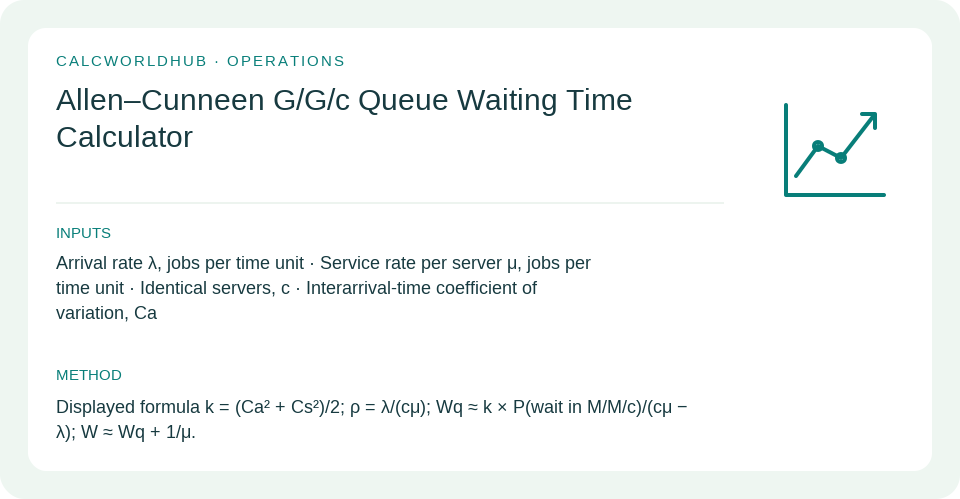
k = (Ca² + Cs²)/2; ρ = λ/(cμ); Wq ≈ k × P(wait in M/M/c)/(cμ − λ); W ≈ Wq + 1/μ.
Method
Compute the Erlang-C probability that an arrival must wait using offered load λ/μ and c identical servers. Multiply the M/M/c mean queue wait by the Allen–Cunneen variability factor. Add one mean service time for the approximate time in the system.
Worked example
With 8 arrivals per minute, 4 servers each completing 3 jobs per minute, Ca = 1.4 and Cs = 0.9, utilization is 66.7%. The Erlang-C wait probability is about 37.84%; the Allen–Cunneen mean queue wait is 0.1310 minute, or 7.86 seconds.
Assumptions and limits
This is a steady-state approximation for identical first-come, first-served servers with an unlimited queue. Arrival and service rates must use the same time unit, and total service capacity must exceed the arrival rate. Coefficients of variation describe interarrival and service times; the approximation is not a simulation.
Frequently asked questions
What is the Allen–Cunneen factor?
It is the average of squared arrival and service coefficients of variation, (Ca² + Cs²)/2, applied to the Erlang-C mean wait.
Why must the system have utilization below 100%?
A steady-state queue cannot clear arrivals when their long-run rate equals or exceeds the combined service capacity.
Does this give an exact queueing result?
No. It is an approximation for a general-arrival, general-service multi-server queue.
How do I use the Allen–Cunneen G/G/c Queue Waiting Time Calculator?
Enter Arrival rate λ, jobs per time unit, Service rate per server μ, jobs per time unit, Identical servers, c, Interarrival-time coefficient of variation, Ca, then complete the remaining labeled fields. Match the units shown beside each field and review the result together with the assumptions below.
What is a worked example of Allen–Cunneen G/G/c Queue Waiting Time?
With 8 arrivals per minute, 4 servers each completing 3 jobs per minute, Ca = 1.4 and Cs = 0.9, utilization is 66.7%. The Erlang-C wait probability is about 37.84%; the Allen–Cunneen mean queue wait is 0.1310 minute, or 7.86 seconds.
Reference: technical reference. See our calculation methodology.