How to use this calculator
Estimate waiting, abandonment, and staffing utilization for a multi-server queue with impatient customers.
- Enter Arrivals per hour (λ), Mean handling time per agent (min), Parallel agents (c), Mean customer patience (min). Match the units shown beside each field and review the result together with the assumptions below.
- Read the worked example below to check the expected input format and result.
- Compare another scenario by changing one input at a time. Use Reset to return to the starting values.
How this calculation works
Erlang A models Poisson arrivals, exponential service times, parallel servers, and exponential customer patience. Unlike Erlang C, it allows waiting customers to abandon before service, so it can represent a call centre or service desk where callers may hang up.
Inputs and units
arrival— Arrivals per hour (λ)- Long-run average incoming customers per hour.
handle— Mean handling time per agent (min)- Average service time; the model converts this to a per-agent service rate.
servers— Parallel agents (c)- Number of identical agents serving at the same time.
patience— Mean customer patience (min)- Mean time a waiting customer is willing to wait before abandoning.
Formula
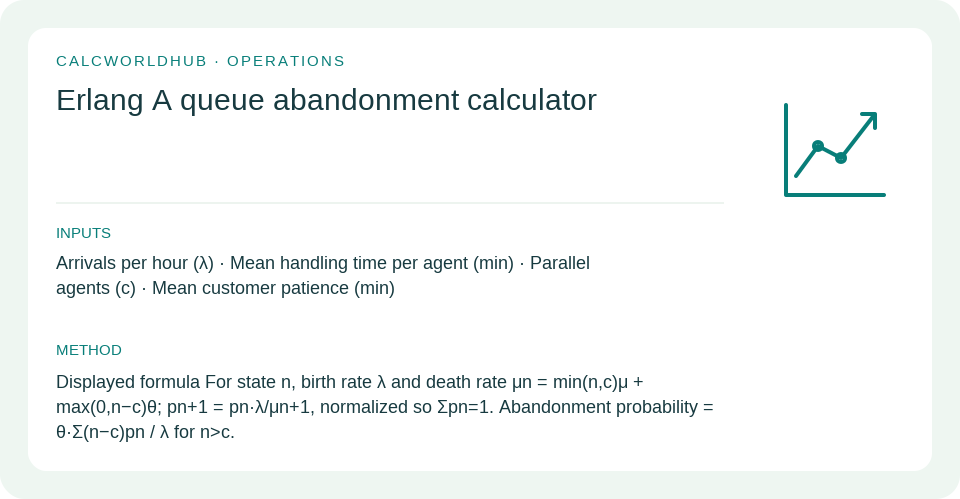
For state n, birth rate λ and death rate μn = min(n,c)μ + max(0,n−c)θ; pn+1 = pn·λ/μn+1, normalized so Σpn=1. Abandonment probability = θ·Σ(n−c)pn / λ for n>c.
Method
Enter arrivals per hour, mean handling time per agent, number of agents, and mean patience time. A birth-death recurrence builds the stationary state probabilities. The results summarize probability of waiting, abandonment flow, average queue length, and server utilization.
Worked example
With one agent, one arrival/hour, a 60-minute mean service time, and a 60-minute mean patience, the stationary state is Poisson(1): about 63.21% wait and 36.79% abandon.
Assumptions and limits
Assumes a stationary M/M/c+M system: Poisson arrivals, exponential handling times, identical independent agents, exponential patience, and constant rates. Real staffing needs also depend on service targets, time-varying demand, skills, breaks, and customer behavior. The numerical state distribution is truncated once its tail is negligible and may reject extreme inputs.
Frequently asked questions
How does Erlang A differ from Erlang C?
Erlang A includes customer abandonment while waiting; Erlang C assumes customers remain until served.
What does average patience mean?
In this model, patience is exponentially distributed with the entered mean, not a fixed deadline for every caller.
Does a low abandonment estimate guarantee a staffing target?
No. This steady-state model omits time-varying arrivals, breaks, skill groups, and service-level targets.
Why might an extreme input be rejected?
The stationary distribution can require a very large state range; the tool limits computation when the tail cannot be safely truncated.
How do I use the Erlang A queue abandonment calculator?
Enter Arrivals per hour (λ), Mean handling time per agent (min), Parallel agents (c), Mean customer patience (min). Match the units shown beside each field and review the result together with the assumptions below.
Reference: Peer-reviewed analysis of the Erlang A abandonment queue. See our calculation methodology.